Liquid chlorine, tablets and granules all sanitise pool water, but they differ in strength, how they’re added, and what else they bring with them. Liquid works fast and adds nothing extra. Tablets are slow-release and usually contain stabiliser. Granules dissolve quickly and vary by type. The “best” one depends on the pool and the routine.
What is liquid chlorine and how is it used?
Liquid chlorine is a concentrated, unstabilised sanitiser that’s poured directly into the pool, usually around the perimeter with the pump running. It works quickly because it dissolves the moment it hits the water, which makes it a common choice for routine dosing and for the kind of chlorine boost described in shocking a pool.
Because it contains no stabiliser, sunlight breaks it down faster than other forms. Pools that rely heavily on liquid chlorine, especially outdoor ones, tend to need more frequent dosing and closer attention to cyanuric acid levels from other sources.
Liquid chlorine also has a limited shelf life. It loses strength in storage, faster in heat and light, which is one reason the “correct” amount on a label can vary between one bottle and the next even from the same product line.
What are chlorine tablets and how do they work?
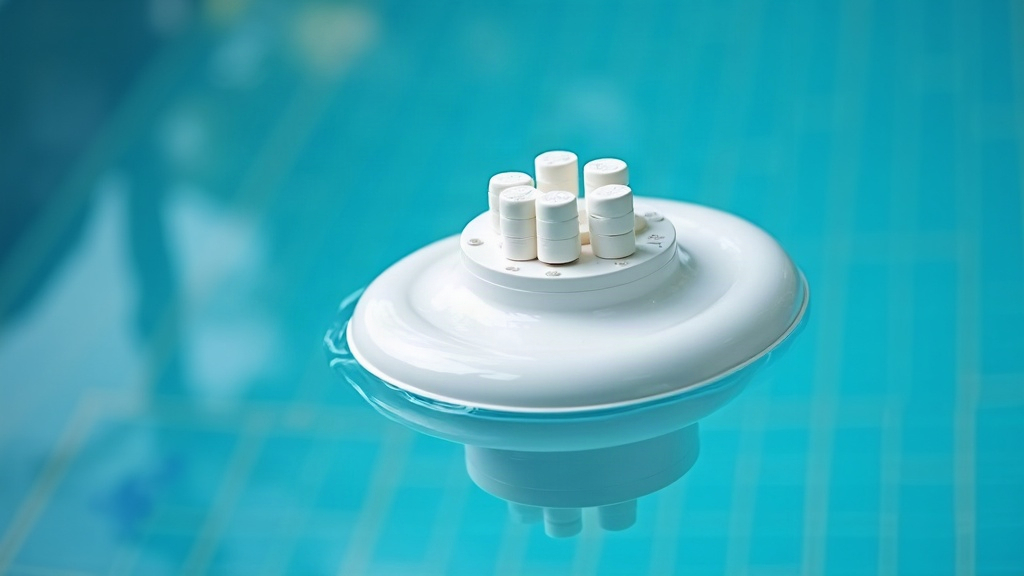
Tablets are a slow-dissolving, stabilised form of chlorine, typically placed in a floating dispenser, an in-line feeder, or a skimmer basket rather than poured straight in. They release chlorine gradually over days, which suits pools that need a steady, low-maintenance baseline between test-and-dose sessions.
Most tablets include built-in stabiliser, which helps chlorine survive sunlight. Used continuously and exclusively, though, that stabiliser accumulates in the water over a season, since it doesn’t break down or filter out on its own. Persistently high stabiliser is one of the things behind chlorine lock, where chlorine struggles to work effectively even at a normal-looking test reading.
Tablets are also mildly acidic in effect over time, which can gradually pull pH and total alkalinity down, meaning they’re often paired with a separate way to raise pH.
What are chlorine granules used for?
Granules are a dry, fast-dissolving chlorine product, often used for routine dosing, shocking, or quick top-ups when a pool is testing low. Some granular products are stabilised, similar to tablets; others are unstabilised and behave more like liquid chlorine in that respect. Reading which type is in the container matters more than assuming granules are all the same.
Granules are typically pre-dissolved in a bucket of water before being added to the pool, following whatever the specific product’s label directs — never poured dry onto a pool surface or added at the same time as another chemical.
Because granules dissolve fast and come in varying strengths and stabiliser content, the label on the container in hand is the only reliable source for how much to use for a given reading and pool volume.
How does stabiliser factor into the choice?
Stabiliser (cyanuric acid) protects chlorine from sunlight, but too much of it makes chlorine less effective even when test strips show a normal free chlorine number. Tablets and some granules add stabiliser every time they’re used; liquid chlorine adds none.
A pool that only ever uses stabilised tablets can end up with climbing cyanuric acid over a season, since the only way it leaves the water is through backwashing, splash-out or partial drain-and-refill. A pool using only liquid chlorine may need stabiliser added separately to get any sun protection at all. Testing for stabiliser occasionally, not just free chlorine, is the way to catch this before it becomes a pattern — more on the difference between free, combined and total chlorine readings and what each one is actually telling you.
Which type raises pH, and which lowers it?
Different chlorine products lean pH in different directions, which is why relying on just one form all season tends to push water chemistry off balance in a consistent way. Tablets tend to push pH and alkalinity down over time; some liquid and granular products push it up. Neither direction is “wrong” — it just means whichever product is used regularly should be paired with regular pH and alkalinity testing, not assumed to be neutral. The relationship between pH and water balance is worth understanding on its own, since it affects comfort, equipment and how well chlorine itself performs.
How should these chemicals be stored?
Chlorine products should always be stored separately from each other and from any acid or pH-adjusting product, in a dry, ventilated space out of direct sun and out of reach of children. Different chlorine types and concentrations should not be stored touching one another either, since even chlorine products mixed together can react.
Chlorine products should never be combined with each other or with acid. Mixing chlorine and acid produces a toxic gas, and this has caused serious injury and death. If a spill happens, follow the product’s safety data sheet rather than trying to neutralise it with another chemical.
Granules and tablets are dry solids and shouldn’t be left in a damp scoop or a closed container that’s holding moisture. Liquid chlorine containers should be kept upright and sealed, since the concentration weakens as it’s exposed to air and heat.
Does the smell of chlorine mean too much has been added?
Not necessarily. A strong chlorine smell is usually a sign of combined chlorine — chlorine that has already reacted with contaminants and needs to be replaced with fresh sanitiser — rather than a sign of too much of any of these products. That’s explained in more detail in why a pool can smell strongly of chlorine when chlorine is actually low.
Which type costs less over a season?
Cost comparisons between liquid, tablets and granules depend on local pricing, how much stabiliser is already needed, and how much sanitiser a particular pool uses through its pump and filtration cycle, so no single number applies everywhere. Tablets are often described as convenient because a dispenser needs refilling less often, but that convenience is separate from cost per dose. Liquid chlorine is usually bought in larger volumes for bigger pools or commercial-style routines, which changes the per-use math again. Comparing products fairly means checking the concentration stated on each label, not just the price on the shelf — background on how pool ownership costs generally break down is covered in the buying and costs section.
How to decide which to use
There’s rarely one “correct” chlorine product for every pool — the right mix usually depends on climate, how often the pool is tested, and what the stabiliser level already looks like.
- Outdoor pools in strong sun often use a stabilised product for a baseline, with occasional unstabilised liquid or granules for top-ups or shocking.
- Pools already testing high for stabiliser generally do better switching toward liquid or unstabilised granules for a while.
- Pools with drifting pH benefit from checking whether the chlorine product itself is a contributing factor.
Whatever combination is used, the label on the specific product is the only reliable guide to how much to add for a given test reading and pool volume. For the wider picture of how sanitiser fits into overall water balance, the water chemistry hub and general pool basics guide are useful starting points before settling on a routine.
Pools Shop publishes general information, not professional advice. Pool chemicals, electrical work and structural work are genuinely hazardous and are governed by local codes that vary — use a qualified professional for anything you are not certain about, and follow the instructions on the product in front of you rather than a general guide. Nothing here is a substitute for active adult supervision around water: no cover, alarm, fence or device makes a pool safe on its own.