Test strips are faster and easier for a quick daily check, while liquid test kits give more precise readings for the numbers that matter most — chlorine, pH, and alkalinity. Most pool owners get the best results using strips for routine glances and a liquid kit for weekly, more careful testing.
What’s the difference between test strips and liquid test kits?
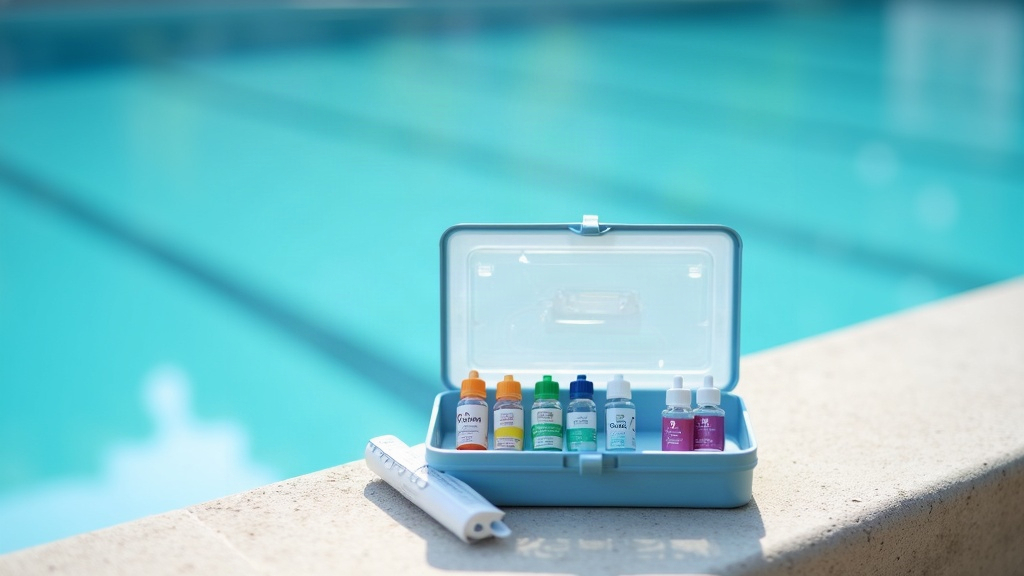
Test strips are thin plastic strips with pads that change color when dipped in pool water. Liquid test kits use reagent drops added to a water sample in a small vial, and the resulting color is compared to a chart. Both methods measure the same basic things, but they get there differently.
Strips are built for speed. Dip, wait a few seconds, compare colors. Liquid kits take a bit longer because each test — chlorine, pH, alkalinity — is usually a separate step with its own reagent and its own color comparison.
Are test strips accurate enough for regular pool care?
Strips are accurate enough for a general sense of where the water stands, but the color bands are wider, so small differences between readings can be harder to see. They’re a reasonable everyday tool, not a precision instrument.
The color pads on a strip are read against a printed chart, and lighting, the angle of view, and how long the strip sits before reading all affect the result slightly. For a fast check before letting anyone near the water, that’s usually fine. For fine-tuning water balance, it’s less reliable.
Why do liquid kits often give more precise readings?
Liquid kits typically use a drop-count method, where reagent is added drop by drop until the water sample changes color. Because the reading is tied to a specific number of drops rather than a single color match, it tends to be more repeatable between tests.
This matters most for readings that drive decisions, like pH and total alkalinity, where a small error can lead to over- or under-adjusting. It also matters for telling free, combined, and total chlorine apart, since that distinction explains a lot about water quality and smell.
What do each of them actually test for?
Most strips and basic liquid kits cover similar ground, though the exact list varies by product:
- Free and total chlorine, which show how much sanitizer is available and how much has already reacted with contaminants
- pH, which affects comfort, equipment, and how well chlorine works
- Total alkalinity, which acts as a buffer that keeps pH from swinging
- Cyanuric acid, sometimes called stabilizer, which affects how quickly chlorine breaks down in sunlight
- Calcium hardness, which affects scaling and surface wear over time
Not every strip or kit tests for all five. Cheaper products often skip calcium hardness and stabilizer, so it’s worth checking the label before assuming full coverage.
Which is easier to use day to day?
Strips win for convenience. There’s no vial to fill, no drops to count, and nothing to rinse out afterward. For a quick check before opening the pool for the day, a strip takes just a few seconds.
Liquid kits ask for more patience. Samples need to be collected properly, reagents added carefully, and results read against a chart in decent light. For someone testing daily, that extra time adds up, which is part of why many owners use strips for daily checks and save the liquid kit for a more thorough weekly test.
Do test strips and liquid kits cost different amounts over time?
Strip containers and liquid kit refills are priced differently pack to pack, and the real cost depends on how often testing happens and how large the pool is. A liquid kit refill often covers more individual tests per dollar than a strip container, since each reagent bottle lasts through many samples.
Strips, on the other hand, tend to have a lower upfront cost and no ongoing reagent purchases beyond replacing the container itself. Neither format is inherently cheaper — it depends on testing frequency and how a household actually uses the pool. For a broader look at what pool ownership costs beyond the testing supplies, the Buying & Costs section covers other recurring expenses.
When does it make sense to use both?
Many pool owners keep both on hand. Strips work well for a fast daily glance — enough to catch an obvious chlorine drop or a pH swing before it becomes a problem. A liquid kit is better suited to the weekly deeper check, or any time the water looks or smells off and a more careful reading is needed.
If a strip result looks unusual — very low chlorine, or pH at either extreme of the chart — following it up with a liquid test on the same sample is a reasonable way to confirm the reading before making any adjustment.
How does regular testing fit into overall pool care?
Testing is only useful if the numbers are acted on. A reading that shows chlorine is present but the water still smells strongly of chlorine often points to combined chlorine rather than free chlorine, which is a different situation entirely. A reading that won’t budge no matter how much sanitizer goes in can be a sign of chlorine lock.
Testing also ties into when a pool needs shocking, and into keeping the water genuinely clear rather than just clear-looking, which the article on what actually makes pool water clear explains in more detail. Cloudy water often has a testing story behind it too — see why pool water goes cloudy for the common causes.
None of this works without decent water movement, either. Testing tells you what’s in the water, but daily circulation and a properly sized turnover rate are what actually distribute sanitizer and keep the whole pool consistent, not just the spot where the sample was taken. The Water Chemistry hub and Pool Basics hub cover the fundamentals behind both testing and circulation in more depth.
What should be kept in mind when storing test kit chemicals?
Liquid test kit reagents are chemicals, even in small quantities, and they should be stored the same way as any other pool chemical: in their original containers, away from children and pets, and separate from chlorine products and acid. Reagents and pool sanitizers should never be combined outside of the specific test procedure printed on the kit’s own instructions.
If a reagent bottle is damaged, unlabeled, or past the point where the color reaction looks normal, it’s reasonable to replace it rather than guess at a result. Always follow the instructions printed on the product in front of you rather than a general routine remembered from a different kit.
So which one should a pool owner actually use?
There’s no single right answer — it depends on how often the water gets tested and how much precision that testing needs. A strip is enough to catch obvious problems quickly. A liquid kit gives a steadier, more repeatable number for the readings that actually drive chemical decisions.
Owners who test daily often find a hybrid approach works best: strips for the quick daily look, and a liquid kit for a slower, more careful weekly check or whenever something about the water seems off. Either way, the goal is the same — catching small chemistry drifts before they turn into bigger problems with clarity, comfort, or equipment.
Pools Shop publishes general information, not professional advice. Pool chemicals, electrical work and structural work are genuinely hazardous and are governed by local codes that vary — use a qualified professional for anything you are not certain about, and follow the instructions on the product in front of you rather than a general guide. Nothing here is a substitute for active adult supervision around water: no cover, alarm, fence or device makes a pool safe on its own.