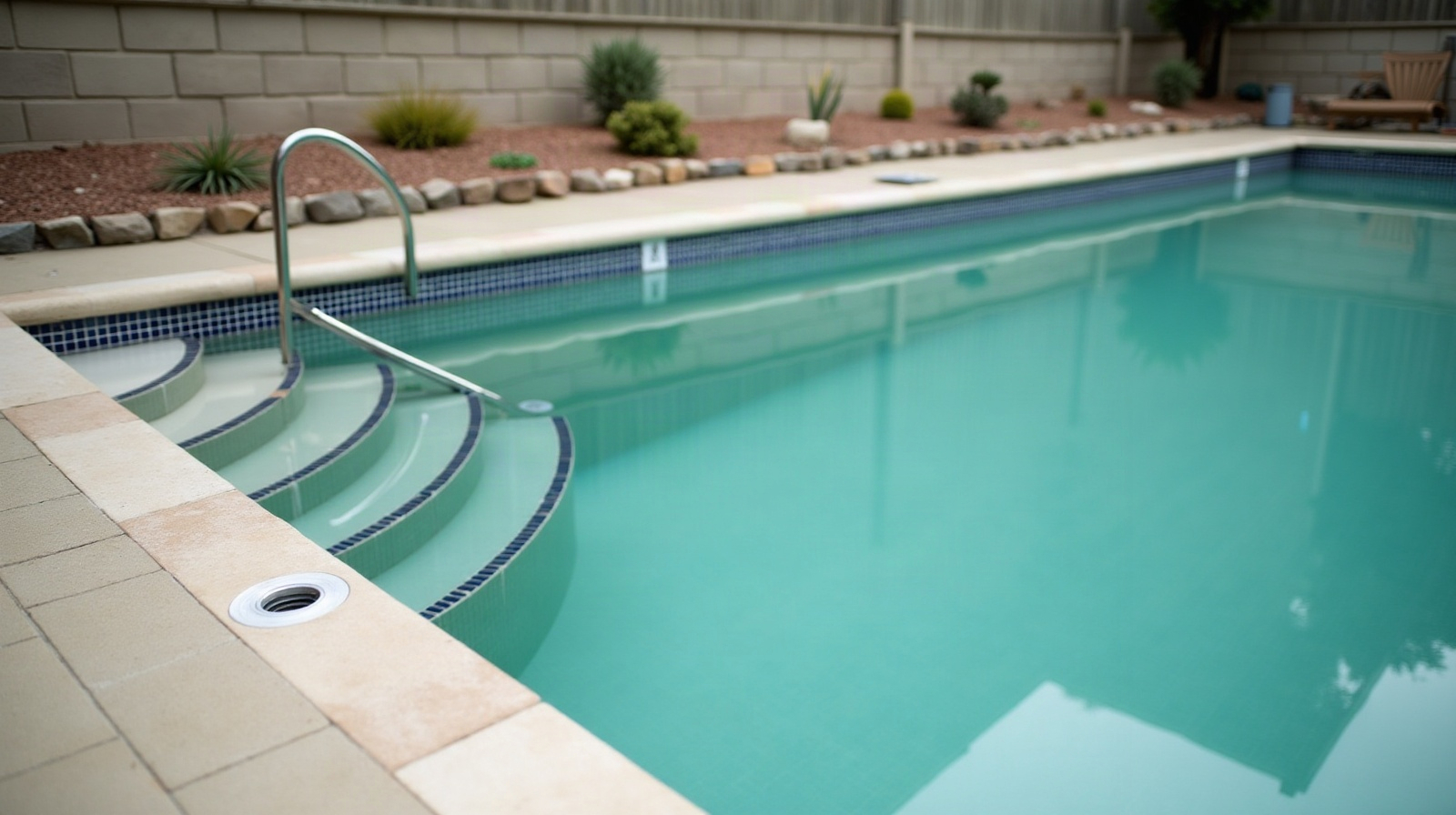
Pools, hot tubs, and the machine underneath them
A pool is a machine, a set of numbers, and a year.
We are pool owners and researchers, not licensed technicians or electricians. This site explains how the machine works, what its numbers mean, and what the pool needs at each point in its year — so you can tell a nuisance from a job for a professional.
Everything on this page describes that pool: the sequence it runs in, the water you can see, the year it moves through, and the numbers that keep it clear.
The loop every drop of water travels
Almost everything that goes right or wrong in a pool traces back to one loop. The pump pulls water out, pushes it through a filter and any heater or chlorinator, and sends it back through the return jets. How a pool circulates water follows that path end to end. Water leaves from two places, and skimmers and the main drain do different jobs: skimmers catch floating leaves and oils at the surface before they sink, while the drain draws from the deepest point.
What a pool pump actually does is simpler than it looks: an impeller spins, creating suction on one side and pressure on the other. Run time is framed as turnover rate, the time needed to move a volume equal to the whole pool. Because filtered water mixes back into unfiltered water, one turnover never cleans every drop, so circulation has to happen daily. Every bend, valve and length of pipe adds resistance, called pump head, and the more of it there is, the less water moves.
A pump’s power draw falls much faster than its flow as it slows, so moving the same water gently over more hours uses far less electricity, the idea behind variable speed pumps. The failure owners meet most is a pump that runs but moves nothing. A pump that loses prime is almost always drawing air, through a low water level, a clogged basket or a suction-side leak.
Three ways to catch dirt
Sand, cartridge and DE filters differ in how fine a particle they catch and how they are cleaned. Sand is the coarsest; a cartridge catches dirt on pleated fabric; diatomaceous earth coats grids in fine powder and catches the smallest particles. As any filter loads, it resists flow more, and the filter pressure gauge shows it: note the reading when clean, and a steady climb means loading. Sand and DE are cleaned by backwashing, reversing flow to flush dirt to waste; cartridges are hosed off. Downstream, gas heaters and heat pumps work in opposite ways: one burns fuel and heats quickly, the other moves heat out of the air and needs mild weather.
Sanitizer, pH and alkalinity pull on each other
Pool chemistry looks like separate readings, but the main ones are linked. What chlorine actually does is oxidize: it reacts with bacteria, algae and the waste swimmers bring in, and is used up doing it, so it must be replaced continuously. Dissolved, it exists partly as hypochlorous acid, the fast-acting form, and partly as hypochlorite, a much slower one. pH sets that balance, which is why pH matters in a pool for more than comfort: at higher pH, the same chlorine reading does less work.
Chlorine that reacts with nitrogen from sweat and urine becomes chloramines, which sanitize poorly and cause the sharp “pool smell” and red eyes. Free, combined and total chlorine are what a good test separates, and a strong smell usually means too little free chlorine, not too much. Sunlight destroys chlorine quickly, so outdoor pools carry cyanuric acid, the stabilizer, which shields chlorine but also slows it. Stabilizer is not used up; it accumulates, and leaves only with water that leaves the pool.
Alkalinity is the buffer. Total alkalinity and pH are easy to confuse: pH is where the water sits, alkalinity is how hard it resists moving. Too little and pH swings; too much and pH creeps upward and will not come down. Calcium is the third leg. Water short of calcium draws it out of plaster and grout, while water carrying too much, especially warm water at high pH, drops it as crust. That is why calcium hardness matters, and why scale appears first on heaters and salt cells.
Where the chlorine comes from
Every form of chlorine carries something else in with it. Liquid chlorine, tablets and granules differ in whether they add stabilizer or calcium, or push pH up or down. A salt pool is not chlorine-free: a saltwater pool uses an electrolytic cell to make chlorine from dissolved salt. Test strips and liquid kits trade speed against precision. When readings show the sanitizer overwhelmed, the usual answer is shocking the pool, raising chlorine well above its everyday level for a time.
The right amount of any product depends on the pool’s volume, today’s readings and that product’s concentration, none of which an article can know. Follow the label on the product in front of you, and ask a pool professional when readings stop making sense. Store chemicals dry, sealed and apart, and never mix pool chemicals: chlorine products combined with acid release toxic gas, and people have died from it.
What cloudy and green water are telling you
What makes pool water clear is the whole system at once: filtration removing particles, sanitizer killing what grows, balanced chemistry keeping minerals dissolved. Lose one and clarity goes, so cloudiness is a clue. Pool water goes cloudy when particles are too fine or too many for the filter, run time is short, calcium falls out of solution at high pH, or sanitizer runs low while something starts to grow. Cloudy water is also a safety problem, because it hides the floor and anyone on it.
Green is almost always algae. Algae takes hold when sanitizer stays low in warm, sunlit water, starting where circulation is weakest. The classic case is a pool turning green right after opening: water that sat for months with its sanitizer spent is suddenly warm. Not every color is biological; stains on pool surfaces can come from leaves or dissolved metals. Prevention is small, regular work. Weekly pool maintenance means testing, emptying baskets, watching the gauge and brushing the walls and floor, which reaches corners where water barely moves.
Opening, closing and the season between
The two transitions are where most trouble starts. Opening a pool for the season means removing the cover, restoring the water level, priming the equipment and correcting chemistry that drifted all winter. In a freezing climate, closing is about water in the wrong place: water expands as it freezes, cracking pipes, pumps and filters from inside. That is why blowing out the lines matters, the core of winterizing a pool. Emptying the pool is usually the wrong instinct; whether to drain for winter turns on what groundwater can do to an empty shell. Hot tubs run the same loop in miniature, and hot tub water chemistry differs because a small volume of hot water is shared by several people, spending sanitizer fast.
Drowning prevention is layered, and supervision is the layer that counts
Drowning is the danger that matters most around a pool, and it falls hardest on young children. It is usually quick and quiet, not the splashing struggle people picture. The World Health Organization’s fact sheet on drowning notes that risk rises when children are around water without active adult supervision. Layered pool safety stacks protections so that when one fails, another remains: barriers, alarms, covers, swimming skills and rescue readiness. No layer makes a pool safe, and none replaces an adult whose only job is watching the water. That is why supervision still matters most.
Each layer has limits. Pool barrier and fence codes are legal obligations in many places and vary between them, so check your local code and permit requirements. A pool alarm reports that someone entered the water; it cannot get them out. A safety cover and a winter cover are different products, and only one is built to bear weight. Making a pool safer for young children starts with every route to the water, from the house as well as the yard. The American Red Cross offers water safety guidance on swimming skills and emergency response.
The equipment has hazards too. Strong suction at a single drain can hold a body or hair against it, which is why drain covers changed under a United States federal law, the Virginia Graeme Baker Pool and Spa Safety Act. Pumps, heaters and lights put electricity beside water, so that wiring is licensed work under local code. Bonding and grounding hold metal parts at the same voltage and give fault current a path that trips the protection; they are for a licensed electrician to install and inspect. Gas lines, structural cracks and excavation belong to licensed trades too.
The sequence
The clarity scale
What you can see, and what it usually means
The one reading you can take without a kit. The green panel stays on this page on purpose — it is the state most owners actually meet, usually in the first week after the cover comes off.
An almanac for the pool year
What does the pool need now?
A pool’s year has six states. Pick the one you’re in — or go to the middle, for the things that are true all year.
Showing Opening — typical for the first warm weeks north of the equator.Showing Running — typical for the long settled middle of a swimming season.Showing Under load — typical for late summer north of the equator.Showing Closing — typical for the first cold nights in a freezing climate.Showing Dormant — typical for a covered pool in a freezing climate.Showing Any time — the things that stay true whatever the pool is doing.Not your pool? Pick any state. Many warm-climate pools never close, and a hot tub’s busiest season is winter.
Opening
The cover comes off, the plumbing refills, and water moves through the filter for the first time in months — usually while the chemistry is still nowhere near where it needs to be.
The jobs
- What Actually Happens When a Pool Is Opened for the Season?
- When Does a Pool Filter Need Cleaning, Not Backwashing?
- What Does Backwashing a Filter Do? A Clear Answer
- What Is Phosphate in Pool Water, and Does It Matter?
What goes wrong now
Running
The long settled middle of the season. Nothing dramatic happens, and the work is small corrections made often rather than big ones made late.
The jobs
- Winter Cover vs Solar Cover: What Each One Actually Does
- Bromine vs Chlorine in a Hot Tub: The Real Difference
- How Long Do Pool Pumps and Filters Typically Last?
- What Does a Filter Pressure Gauge Actually Tell You?
What goes wrong now
Under load
Warm water, long sun and heavy use burn through sanitiser faster than at any other point in the pool’s year, while the filter takes on more debris than it was sized for.
The jobs
- What Is Biofilm in a Hot Tub, and Why Does It Matter?
- How Is Hot Tub Water Chemistry Different From a Pool?
- What Is Scale and Why Does It Form in a Pool?
- Dealing With Pool Leaves Without Wrecking the Equipment
What goes wrong now
Closing
Everything that can freeze has to come out, and everything that stays has to be able to sit for months without attention.
The jobs
- Safety Cover vs Winter Cover: What’s the Real Difference?
- Winter Cover vs Solar Cover: What Each One Actually Does
- Should a Pool Be Drained for Winter? The Real Answer
- What Does Winterising a Pool Involve? A Clear Guide
What goes wrong now
Dormant
Covered and still. Very little to do, and a short list of things worth checking so that opening is not a rescue.
The jobs
- Safety Cover vs Winter Cover: What’s the Real Difference?
- Winter Cover vs Solar Cover: What Each One Actually Does
- How Long Does a Hot Tub Cover Last, and Why It Matters
- How Often Should Pool Water Really Be Replaced?
What goes wrong now
Any time
The things that stay true whatever the pool is doing — how the machine works, what the numbers mean, and where the site stops.
The jobs
- What Does Pool Maintenance Actually Take Each Week?
- What Questions Are Worth Asking a Pool Builder?
- The Ongoing Pool Jobs Nobody Mentions Before You Buy
- Above Ground vs In Ground Pool: The Real Difference
What goes wrong now
What the numbers mean
One example pool, drawn as positions rather than targets. Yours will differ — always follow your own test kit.
A number outside its band is information, not an emergency — it tells you which job is next. We do not publish doses, and the order on the strip above matters more than any single reading.
Recently
Newest on the site
Everything, by subject
Where things live
Where this site stops
We explain how things work and what readings mean. We do not publish doses, we never describe mixing chemicals, and anything involving gas, bonding, electricity or structure belongs to a licensed trade. No device on any page removes the need for supervision.
- Anything electrical near water — a licensed electrician, every time.
- Gas heaters and their flues — a qualified gas engineer.
- Bonding and grounding — not a DIY job, and not a visual check.
- A cracked shell, a moving coping stone, a pool that will not hold water.