Chlorine’s job in a pool is to kill bacteria, viruses and algae, and to break down organic waste like sweat, urine and sunscreen before it builds up. It does this through a chemical reaction, not by “cleaning” water the way a filter does — chlorine and filtration are two separate, equally necessary jobs.
What is chlorine actually doing in the water?
Once a chlorine product dissolves, it forms compounds that react with cell walls of bacteria and other microorganisms, disabling them. It also reacts with organic matter — skin cells, oils, dead algae — breaking it down into smaller, less harmful pieces. This is why chlorine is described as both a disinfectant and an oxidizer.
Filtration and circulation remove particles physically. Chlorine handles what filtration cannot: living organisms and dissolved waste that would pass straight through a filter. A pool needs both. Understanding how a swimming pool actually circulates water helps explain why chlorine alone, sitting in a corner with no flow, does very little for the pool as a whole.
What is “free chlorine” versus “combined chlorine”?
Free chlorine is the active, available chlorine still capable of disinfecting. Combined chlorine is chlorine that has already reacted with waste and is mostly spent. Total chlorine is simply the two added together, and it’s the free chlorine number that actually tells you what’s working.
A test kit or test strips should report both free and total chlorine. If total chlorine reads noticeably higher than free chlorine, that gap is combined chlorine — a sign the pool has been working hard against organic waste and may need attention. This is part of why pool water can look clear and still smell strongly of “chlorine”: that smell is usually combined chlorine byproducts, not fresh, active chlorine.
Why does chlorine seem to disappear so fast?
Sunlight breaks chlorine down quickly, bather waste consumes it, and heat speeds up every reaction in the water. A pool sitting in full sun with people swimming in it will use chlorine far faster than a shaded, unused pool. This is normal chemistry, not a sign anything is broken.
Some chlorine products include an additive that helps chlorine resist sunlight breakdown for longer. Whether a particular pool needs that additive, and how much is already present, is exactly the kind of question a test kit answers and a product label addresses — this article won’t guess at numbers because the right level depends on the pool’s volume and current readings.
Does chlorine need anything else to work properly?
Yes. Chlorine’s effectiveness depends heavily on pH. If pH drifts too high, a large share of the chlorine in the water becomes far less effective at disinfecting, even though a test might still show a “chlorine” number. If pH drifts too low, chlorine works faster but the water becomes more likely to irritate skin and eyes and to damage pool surfaces and equipment over time.
This is why every water test that checks chlorine should also check pH. The two are read together, not separately. The Water Chemistry hub covers pH, alkalinity and other readings in more depth for readers who want the fuller picture beyond chlorine alone.
Why does the water still look cloudy even with chlorine in it?
Chlorine kills organisms and breaks down waste, but it doesn’t filter out fine particles, and it can’t compensate for poor circulation, a dirty filter or unbalanced water. Cloudiness is almost always a filtration or balance problem layered with — not solved by — the chlorine level.
For a deeper look at the usual culprits, see why pool water goes cloudy and what actually makes pool water clear. Chlorine is one ingredient in clear water, not the whole recipe.
What forms does chlorine come in?
Chlorine products come as tablets, granules, liquid, and as part of automated feeder or generator systems. Each has a different concentration and a different way it’s meant to be introduced to the water — through a feeder, a skimmer, or dosed directly, depending on the product.
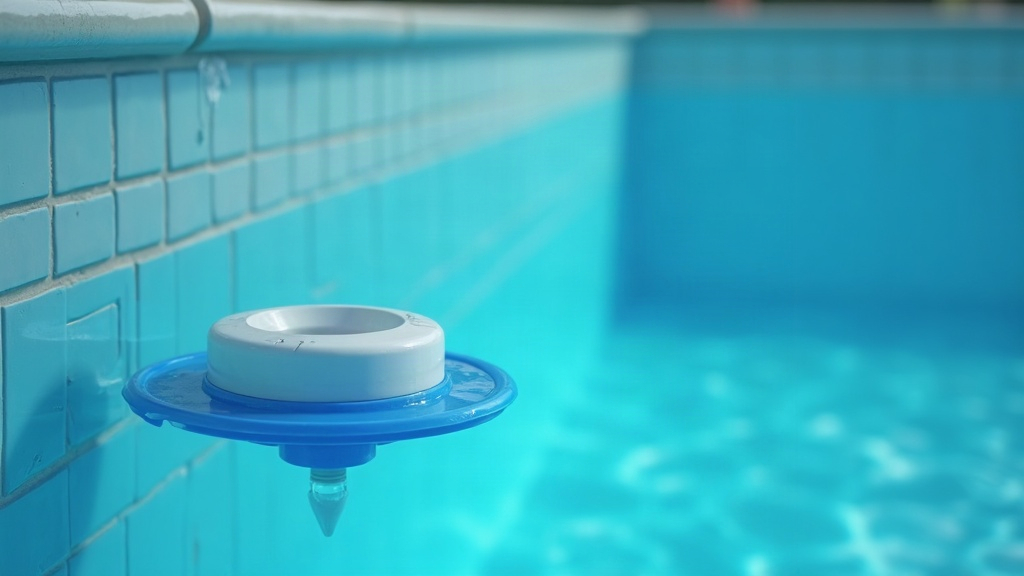
- Tablets are often used in a floating or in-line feeder for slow, steady release.
- Granules are typically dissolved and added by hand for a quicker boost.
- Liquid chlorine acts fast and is common on larger or commercial-style pools.
- Salt-based systems generate chlorine on-site from dissolved salt using an electrical cell.
Because concentrations differ between products, the amount to add always depends on the specific product’s label, the pool’s water volume, and current test results — not on a general rule. Follow the instructions printed on the container in front of you.
Is it safe to store chlorine products near other pool chemicals?
Chlorine products should always be stored separately from acids and other pool chemicals, in a dry, ventilated space out of direct sunlight, and never combined in a bucket, feeder or any other container. Mixing chlorine with acid produces a toxic gas, and this combination has caused serious injury and death.
Keep chemicals in their original, labeled containers, keep them away from children and pets, and read the storage instructions on each product separately. If a job involves handling multiple chemicals at once, treat that as a reason to slow down and double-check labels, not a reason to combine anything to “save a step.”
Does chlorine affect the pool’s equipment?
Chlorine that’s out of balance — too high, too low, or paired with poor pH — can corrode metal fittings, bleach liner surfaces and shorten the working life of components on the equipment pad. Well-balanced water is easier on every part of the system, not just on skin and eyes.
A quick look at what a pool equipment pad actually is and what’s on it helps explain why chemical balance and equipment condition are linked rather than separate topics. Anything involving the pump, heater or electrical connections on that pad is licensed work — wiring, bonding and grounding near water are code-governed, and a qualified electrician or pool professional should handle that side of it.
Does chlorine keep a pool “safe” for swimming?
No. Chlorine reduces the risk of illness from bacteria and waste in the water, but it has no effect on drowning risk. A perfectly chemically balanced pool is exactly as dangerous to an unsupervised child as an untreated one — chlorine has nothing to do with that layer of risk.
Drowning prevention comes from layers working together: a compliant barrier, a working alarm, supervision, and swimming ability — and supervision by a designated adult who is actively watching the water is the layer that matters most. No product, chemical or otherwise, replaces that. Barrier, fence and alarm requirements vary by location, so check local code and permit requirements rather than assuming a standard that applies everywhere.
How does chlorine fit into overall pool maintenance?
Chlorine is one part of a routine that also depends on steady circulation, a clean filter, and balanced water chemistry working together. None of these compensates for a failure in the others.
New pool owners often underestimate how much of “chemistry” is really about consistent circulation. Reviewing why a pool needs to be circulated every day and what turnover rate is and why it matters rounds out the picture chlorine is only one piece of. For a broader starting point on pool upkeep generally, the Pool Basics hub is a good next stop.
What should a new pool owner actually test for?
A basic testing routine should check free chlorine, total chlorine, and pH at minimum, with alkalinity checked regularly as well. Testing after heavy pool use, after rain, and after any big chemical addition catches problems before they become visible.
Test kits and strips vary in what they measure and how precisely, so it’s worth checking a specific product’s own instructions for how to read and interpret results. When in doubt about a reading, retesting is cheaper and safer than guessing and adding more product on top of an unclear result.
Pools Shop publishes general information, not professional advice. Pool chemicals, electrical work and structural work are genuinely hazardous and are governed by local codes that vary — use a qualified professional for anything you are not certain about, and follow the instructions on the product in front of you rather than a general guide. Nothing here is a substitute for active adult supervision around water: no cover, alarm, fence or device makes a pool safe on its own.