A pool’s equipment pad is the concrete or gravel area, usually tucked against a wall or fence, where the pump, filter, and often the heater and automation gear all sit together. It’s the mechanical heart of the pool — everything that moves, cleans, and heats the water lives there, connected by a maze of PVC pipe.
Understanding what’s on the pad doesn’t require any technical training. It just means knowing which box does which job, so a reader can describe a problem accurately to a pro, or notice something looks wrong before it becomes expensive.
What is the equipment pad, exactly?
The equipment pad is the dedicated space — a slab, a pad, sometimes a small enclosure — where a pool’s pump, filter, and related hardware are mounted outside the pool shell itself, connected by underground or above-ground plumbing.
It’s usually placed as close to the pool as local code and site layout allow, since shorter pipe runs mean less resistance for the pump to push against. Most pads are outdoors, though some indoor or climate-restricted setups tuck equipment into a mechanical room instead.
For readers just getting oriented with pool components generally, the Pool Basics archive covers the fundamentals in plain language.
What does the pump do on the pad?
The pump is the component that physically moves water — pulling it from the pool through the skimmer and main drain, pushing it through the filter, and returning it to the pool. Without the pump running, nothing else on the pad does anything.
It’s typically the loudest and most visible piece of equipment, mounted low so it can draw water by suction. A basket sits inside the pump housing to catch leaves, hair, and debris before it reaches the impeller.
For a deeper look at how this part of the system works, see What Does a Pool Pump Actually Do? and How Does a Swimming Pool Actually Circulate Water?.
What does the filter do?
The filter is the tank-shaped unit that strains fine debris out of the water after the pump has moved it there. Water enters, passes through a filtering medium, and exits clean before heading back toward the pool through the return lines.
Three types show up on most residential pads:
- Cartridge filters use pleated fabric elements that get hosed off or replaced periodically.
- Sand filters push water through a bed of specialized sand and get cleaned by backwashing.
- DE (diatomaceous earth) filters coat a grid with a fine powder for very thorough filtration, also cleaned by backwashing.
None of these filters run on their own schedule they’ve simply built up — how long they run each day connects directly to how the whole pool circulates. That relationship is explained in Why Does a Pool Need to Be Circulated Every Day? and What Is Turnover Rate and Why Does It Matter?.
What are all those valves for?
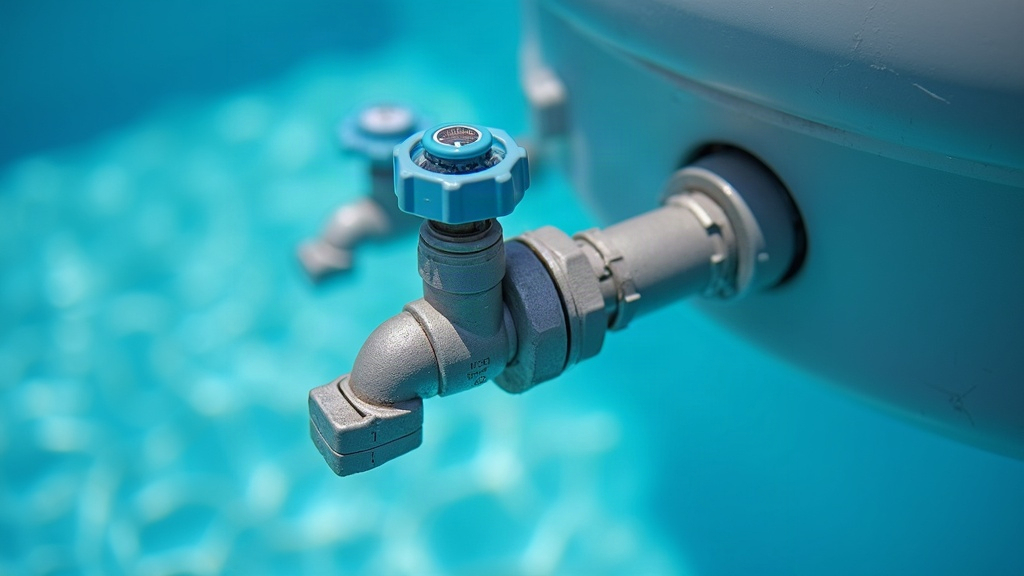
Valves on the pad direct where water goes — toward the skimmer or the main drain, through the filter or around a heater, out to a cleaner line or back to the pool. Multiport valves on sand and DE filters also switch between filtering, backwashing, and other modes.
A reader doesn’t need to memorize every valve position, but it helps to know that turning a valve mid-cycle can change pressure and flow suddenly. If a valve seems stuck, cracked, or leaking at the handle, that’s worth mentioning to a pool professional rather than forcing it.
The difference between the two main suction points these valves manage is covered in Skimmer vs Main Drain: What’s the Real Difference?.
Is the heater part of the equipment pad?
Yes, when a pool has one — gas heaters, heat pumps, and the plumbing and gas or electrical connections that serve them are usually mounted right on the pad alongside the pump and filter, downstream in the water’s path.
Heaters are more complex than a pump or filter because they involve either a gas line or a significant electrical circuit, plus bonding and clearance requirements. Installing or relocating one is licensed work — a gas fitter or electrician needs to size the line or circuit correctly and meet local code, and that isn’t a weekend DIY project. A homeowner’s role is knowing what questions to ask: fuel type, expected run time to reach temperature, and clearance from structures.
Pool builds and renovations that involve a heater often shift the whole budget conversation — see the Buying & Costs archive for what tends to drive those numbers up or down.
What else might be sitting on the pad?
Depending on the pool’s age and features, the pad may also hold:
- A salt chlorine generator cell, which produces chlorine from salted water as it passes through.
- An automation or timer panel that schedules pump run time and controls valves or lights.
- A booster pump dedicated to a pressure-side cleaner or water feature.
- A pressure gauge on the filter that shows when it’s due for cleaning.
- Electrical disconnects and bonding wire, required by code near pool equipment.
Any of the electrical components on the pad — the pump’s motor connection, the heater’s power supply, bonding lugs — are governed by code because they sit near water. Wiring or rewiring any of it is licensed electrician work, not something to improvise.
Why does the equipment pad matter for pool problems?
A lot of common pool symptoms trace back to something on the pad, which is why techs and knowledgeable owners look there first. Cloudy water, weak returns, or a pump that won’t prime often point to a valve position, a dirty filter, or an air leak somewhere between the pool and the pad.
Water loss is another example. Before assuming a leak, it’s worth ruling out normal evaporation, which is explained in Evaporation vs Real Pool Leak: How to Tell the Difference, and considering the everyday causes covered in Why Do Pools Lose Water Even With No Leak?. A puddle or damp patch specifically around the pad’s plumbing fittings, though, is a good reason to call a professional rather than guess.
What should a new pool owner check on the pad?
A new owner doesn’t need technical skills to do a basic visual check — just knowing what normal looks like. Look for cracked pipe, visible corrosion on fittings, a filter pressure gauge reading well outside its usual range, or standing water where there shouldn’t be any.
None of this is a substitute for a professional inspection, especially on an older pool or one being purchased. Anyone shopping for a home with a pool, or comparing pool types before building one, may also find it useful to read Vinyl Liner vs Fiberglass vs Concrete Pool: The Real Differences, since the shell type affects how the equipment pad connects to the pool.
For ongoing questions about pumps, filters, and heaters specifically, the Pumps, Filters & Heaters archive collects plain-language explanations of how each part works and what commonly goes wrong.
A note on chemicals near the pad
Pool chemicals are often stored near the equipment pad for convenience, but they should be kept in a dry, ventilated space separate from each other — never combined, and never mixed together in any container. Chlorine-based products mixed with acid-type products can produce dangerous gas, which is why labels warn against storing them side by side. Always follow the storage and handling instructions printed on the product itself rather than general advice, since concentrations vary by brand.
A final word on safety around the pad and the pool
The equipment pad is mechanical and electrical, and none of the fencing, covers, or alarms a pool might have change what happens at the pad — those layers address drowning risk in the water, not equipment safety, and none of them, individually or together, replace a designated adult actively watching anyone in or near the pool. Local code sets requirements for barriers and alarms in many places, and it’s worth checking those requirements directly rather than assuming a standard applies everywhere.
Pools Shop publishes general information, not professional advice. Pool chemicals, electrical work and structural work are genuinely hazardous and are governed by local codes that vary — use a qualified professional for anything you are not certain about, and follow the instructions on the product in front of you rather than a general guide. Nothing here is a substitute for active adult supervision around water: no cover, alarm, fence or device makes a pool safe on its own.