Calcium hypochlorite is a solid chlorine, usually a granule or tablet, that carries calcium along with it. Sodium hypochlorite is a liquid chlorine, close cousin to household bleach, that carries sodium instead. Both sanitize water. The difference that actually matters to an owner is what each one adds behind the chlorine, and whether the pool can absorb that.
What exactly is calcium hypochlorite?
Calcium hypochlorite, often called cal-hypo, is sold as granules, powder, or tablets. It releases chlorine into the water and leaves calcium behind as a byproduct. It’s typically a stronger, more concentrated form of chlorine by weight than liquid bleach, which is part of why it’s popular for shocking a pool. It also tends to store longer than liquid chlorine if kept dry and sealed.
What exactly is sodium hypochlorite?
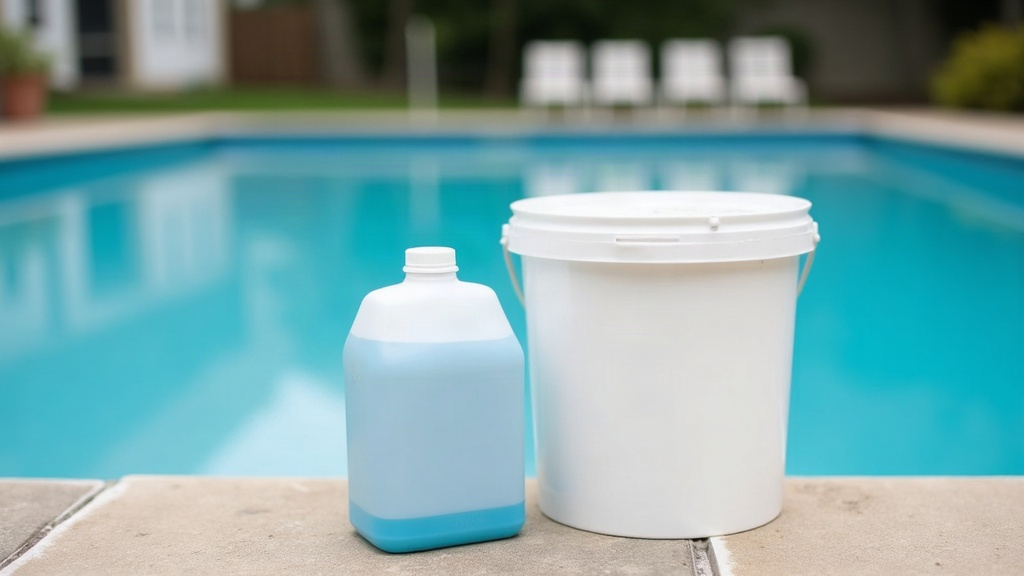
Sodium hypochlorite is a liquid, delivered in jugs or drums at pool-supply stores, and it’s chemically similar to the bleach sold for laundry, just usually stronger. It releases chlorine and leaves sodium behind. It has no calcium content at all. Liquid chlorine loses strength faster than granules, especially in heat and sunlight, so it’s typically bought closer to when it will be used.
Neither product should ever be stored near acid-based pool chemicals or mixed with them directly. Combining chlorine products with acid can produce toxic gas, and this has caused real injuries and deaths. Store chemicals separately, in their original containers, away from each other. For more on that, see why pool chemicals should never be mixed and what owners need to know about chemical storage.
Why does the calcium in cal-hypo actually matter?
Every bit of cal-hypo used raises calcium hardness a little more. Over a season of regular use, that effect adds up. If hardness climbs too high, the pool can develop scale on tile, heater surfaces, and pipe walls. Sodium hypochlorite does not carry this risk, because it adds no calcium at all.
This is the real decision point, and it’s one most comparisons skip. The right choice depends on what the water is already carrying, not just on price or convenience.
How do you decide which one to use?
The decision comes down to a single number: calcium hardness, measured in parts per million (ppm). A test kit or strip will give that reading. Here’s a simple way to use it.
| Calcium hardness reading | What it means | Better fit |
|---|---|---|
| Below roughly 150-200 ppm, or known soft fill water | Pool surfaces and metal fittings are more exposed to corrosion | Calcium hypochlorite — the calcium it adds is genuinely useful here |
| Roughly 200-250 ppm | Hardness is in a workable middle range | Either product can work; watch the trend over time |
| Above roughly 250-300 ppm, or hard fill water | Water is already close to or past where scale risk rises | Sodium hypochlorite or liquid chlorine — avoid adding more calcium |
These figures are general ranges, not fixed thresholds. Test kit manufacturers publish their own ideal ranges, and local fill water varies a lot by region. The pattern that matters is simple: low hardness plus cal-hypo helps correct a corrosion-prone pool. High hardness plus cal-hypo pushes an already hard pool further toward scale. For background on hardness itself, see why calcium hardness matters.
What does hard water actually look like in a pool?
Scale shows up as a rough, grayish-white crust, often first noticed at the waterline tile or inside heater elements. What scale is and why it forms covers the mechanics in more detail. It’s gradual, not sudden, which is exactly why a hardness test is worth doing before choosing a chlorine product rather than after scale has already formed.
On the other side, water with low hardness can feel aggressive toward plaster, grout, and metal fittings. Some corrosion-prone pools benefit from a steady, gentle calcium top-up, and that’s precisely the job cal-hypo does well. It’s not a flaw in the product. It’s a feature, used in the wrong place.
Does concentration change how much is used?
Cal-hypo and liquid chlorine are not sold at the same strength, and products within each category vary too. This article won’t give a dose, because the right amount depends on the pool’s volume, current chlorine and pH readings, and the specific product’s labeled concentration. Always follow the instructions on the container in front of you, and test the water before and after. For the general testing approach, see the water chemistry section and test strips versus liquid test kits.
Does this choice affect pH too?
Yes, though less dramatically than hardness. Cal-hypo tends to push pH slightly upward, while sodium hypochlorite tends to do the same but by a different margin depending on the product. Either way, pH needs checking after use, not assumed. What pH is and why it matters and total alkalinity versus pH both help make sense of the readings.
Which one is easier to handle and store?
Granular cal-hypo is easier to transport and tends to have a longer shelf life if kept cool, dry, and sealed. Liquid sodium hypochlorite is heavier to carry, degrades faster, and can bleach fabric or damage surfaces if spilled. Both need to be kept away from direct sunlight, away from acids, and out of reach of children. Supervision around a pool area matters for more than water depth — chemical storage sheds and pump rooms are not safe to treat as play spaces, and nothing about safe storage replaces an adult watching where kids are and what they can reach.
Where this fits with the rest of pool upkeep
Chlorine choice is one piece of a bigger weekly routine that includes testing, brushing, and filter care. For the fuller picture, see what pool maintenance actually takes each week and the cleaning and maintenance archive. If hardness or sanitizer choice keeps causing confusion, it’s often worth asking a pool-supply counter to read a full water test panel rather than guessing from one number alone.
Pools Shop publishes general information, not professional advice. Pool chemicals, electrical work and structural work are genuinely hazardous and are governed by local codes that vary — use a qualified professional for anything you are not certain about, and follow the instructions on the product in front of you rather than a general guide. Nothing here is a substitute for active adult supervision around water: no cover, alarm, fence or device makes a pool safe on its own.