Calcium hardness matters because it controls whether pool water pulls calcium out of plaster, grout and equipment (when it’s too low) or deposits scale onto surfaces and clogs plumbing (when it’s too high). Keeping it in a reasonable range protects the pool’s finish and its circulation system over time.
What is calcium hardness, exactly?
Calcium hardness is a measurement of how much dissolved calcium is in the pool water, usually reported in parts per million. It is one of the core numbers pool owners test alongside pH and total alkalinity, and it behaves differently from both.
Water is naturally a solvent. If it doesn’t have enough calcium already dissolved in it, it will look for calcium elsewhere — often pulling it from plaster, grout lines, or concrete. If it has too much, the excess calcium has nowhere to go and starts coming out of solution as scale.
Why does low calcium hardness cause problems?
Low calcium hardness makes water “aggressive.” It seeks calcium from any available source, which can etch plaster, roughen grout, and pit soft metal fittings over months and years of exposure.
This kind of damage is slow and often blamed on age or poor workmanship, when the underlying cause was water chemistry quietly working against the surfaces the whole time. It’s a good reason to test regularly rather than only when something looks visibly wrong.
Why does high calcium hardness cause problems?
High calcium hardness pushes water toward depositing scale — a cloudy, crusty white buildup — on tile, plaster, heater elements and pipe interiors. It can also make water look hazy even when disinfection is otherwise fine.
- Scale on tile and waterlines is unsightly and difficult to remove without abrasive cleaning.
- Scale inside heat exchangers reduces how efficiently a heater transfers heat.
- Scale buildup inside pipes and around valves can gradually restrict flow.
Because scale tends to form wherever water is heated or under the most turbulence, heaters and pump components often show the effects before anything visible appears on the pool walls. If a pool relies on a heater, the equipment pad is worth checking for early scale signs — see what a pool equipment pad is and what’s on it for a rundown of what’s typically installed there.
How does calcium hardness relate to pH and alkalinity?
Calcium hardness, pH and total alkalinity work together to determine whether water is scale-forming, corrosive, or reasonably balanced. None of the three tells the full story on its own.
A pool can have “normal” calcium hardness and still trend toward scale if pH and alkalinity are both running high at the same time. The reverse is also true — hardness within range doesn’t protect a plaster surface if the pH is chronically low. This is why testing looks at the whole picture rather than one isolated number. For more on how pH behaves and why it’s tracked closely, see what pH is and why it matters in a pool, and for how alkalinity acts as a buffer for pH, see total alkalinity vs pH: what’s the real difference.
What raises or lowers calcium hardness?
Calcium hardness rises when calcium-based products are added to the water, and also through natural sources like fill water, calcium-based sanitizers, or even the water evaporating and concentrating existing minerals. It’s lowered mainly through dilution — draining some water out and replacing it with lower-hardness fill water.
There isn’t a way to “chemically strip” calcium out of a full pool the way pH or chlorine levels can be nudged with a product. If hardness is significantly too high, partial drain-and-refill is usually the practical path, and that’s a decision worth checking against local water restrictions and drought rules first.
Whatever product is used to raise calcium hardness or manage scale, always follow the label instructions on the container in front of you rather than a general rule from an article, since concentration and dosing vary by brand. Chemical containers should always be stored separately from one another — never combine pool chemicals directly, and this is especially true for chlorine products stored near acids, which can react to release dangerous gas.
How do you test calcium hardness at home?
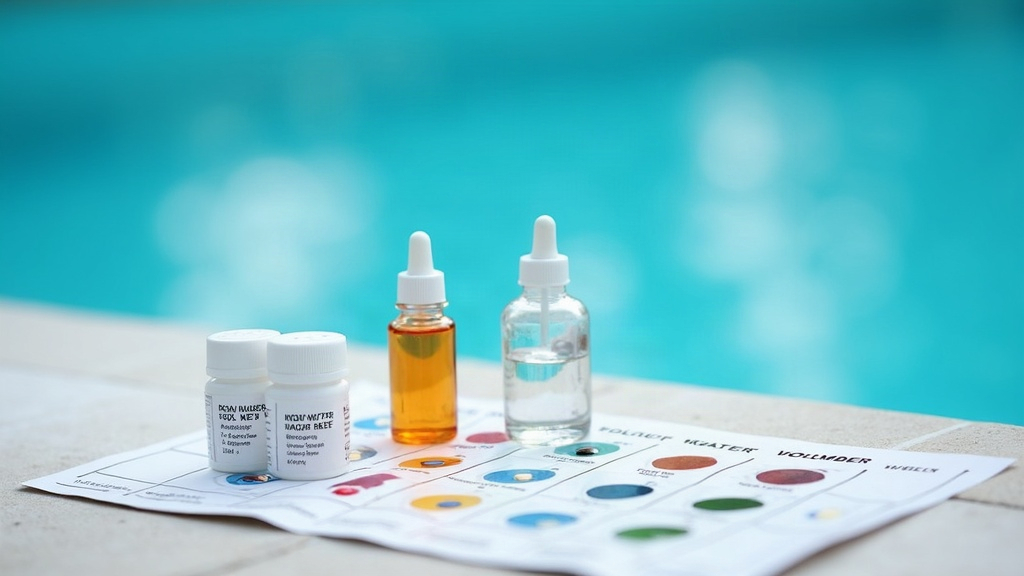
Calcium hardness is typically tested with a home test kit or test strips designed to include it, since many basic strips only cover chlorine and pH. A titration-style kit tends to give a more precise reading than color-match strips.
Testing calcium hardness isn’t usually a daily task the way chlorine and pH checks are. Many pool owners check it every few weeks, or more often in areas with hard fill water or heavy evaporation. If a pool is regularly topping itself off due to evaporation, hardness levels can climb faster than expected — see why pools lose water even with no leak for context on how evaporation concentrates dissolved minerals over time.
Does calcium hardness matter differently for different pool surfaces?
Yes. Plaster and other cementitious surfaces are the most sensitive to low calcium hardness because they’re literally made from materials water can dissolve. Vinyl liner and fiberglass surfaces are less chemically reactive to hardness swings, though scale can still form on tile, ladders, and equipment in any pool type regardless of the shell material.
For a broader comparison of how these surface types differ in maintenance needs, see vinyl liner vs fiberglass vs concrete pool: the real differences.
Can calcium hardness affect water clarity?
Yes, high calcium hardness combined with high pH can create a hazy, cloudy look even when sanitizer levels are fine, because fine calcium particles suspended in the water scatter light. This is one of several possible causes of cloudy water, alongside filtration and disinfection issues.
If a pool looks persistently cloudy, hardness is worth checking as part of the process of elimination described in why pool water goes cloudy, alongside the broader factors covered in what actually makes pool water clear.
Does calcium hardness affect equipment, not just the pool surface?
Yes. Heaters are usually the most exposed piece of equipment, since scale forms preferentially in the hottest parts of a system. A heat exchanger coated in scale has to work harder to transfer the same amount of heat, and in persistent cases that extra strain can shorten how long the unit performs well.
Pumps, filters and valves can also collect scale over time, particularly in systems with poor circulation or long periods of stagnant water. Good daily circulation helps keep water moving and chemistry more even throughout the pool rather than concentrating in pockets — see why a pool needs to be circulated every day and what a pool pump actually does for how that process works.
Any suspected heater scaling, corrosion, or performance problem involving the heating or electrical side of the equipment is a job for a licensed technician familiar with local code — this is not a weekend DIY repair, and it isn’t safe to open up gas or electrical components without that training.
What happens if calcium hardness is ignored long-term?
Ignoring it long-term generally goes one of two ways: an aging surface that etches, roughens or discolors from years of aggressive water, or a slow accumulation of scale on tile, heater components and pipe walls that gets more expensive to remove the longer it sits.
Both outcomes are gradual, which is exactly why regular testing matters — the damage isn’t obvious in the moment, but it adds up. Pairing hardness checks with routine total alkalinity, pH and chlorine testing (see free vs combined vs total chlorine: what’s the difference) gives a fuller picture of where the water actually stands.
What’s a reasonable testing routine for calcium hardness?
Most pool owners fold calcium hardness into a broader monthly or biweekly water test rather than checking it daily. Testing more often makes sense after a partial drain-and-refill, after heavy rain, or during periods of high evaporation.
- Test after any significant water replacement, since fill water hardness varies by source.
- Test more frequently in hot, dry climates where evaporation concentrates minerals faster.
- Log results over time so a slow drift up or down is caught before it becomes a problem.
For pool owners still getting familiar with the basics of routine water testing and what each number is checking for, the Water Chemistry section and Pool Basics section cover the fundamentals in more depth. For anyone weighing equipment repair or replacement costs tied to scale damage, the Buying & Costs section and Pumps, Filters & Heaters section are useful starting points for understanding what drives those costs.
Calcium hardness isn’t the most talked-about number in pool chemistry, but it’s one of the quieter ones that determines whether a pool’s surfaces and equipment age gracefully or wear out ahead of schedule. Regular testing and treating it as part of the overall balance — not an isolated fix — is the most reliable way to stay ahead of it.
Pools Shop publishes general information, not professional advice. Pool chemicals, electrical work and structural work are genuinely hazardous and are governed by local codes that vary — use a qualified professional for anything you are not certain about, and follow the instructions on the product in front of you rather than a general guide. Nothing here is a substitute for active adult supervision around water: no cover, alarm, fence or device makes a pool safe on its own.