Pool chemicals should never be mixed because many of them react with each other instead of blending safely. Chlorine products combined with acid, for example, can release toxic gas. Different sanitizers can react violently together too. The safe rule is simple: add one product at a time, to water, and never combine chemicals directly.
What actually happens when pool chemicals are combined?
Pool chemicals are concentrated substances designed to react with water, not with each other. When two incompatible products touch directly — as a splash, a spill, or a careless “just add it in too” moment — the reaction can be fast, hot, and produce fumes that are dangerous to breathe. This is not a theoretical risk. Chlorine-based sanitizers mixed with acid have caused serious injuries and deaths, which is why chemical manufacturers and safety agencies are firm about it.
It is not only chlorine and acid. Different types of chlorine products (for example, one sanitizer combined with another oxidizer) can also react unpredictably. The safest working assumption is that pool chemicals are formulated to go into a large volume of water, one product at a time, never into each other.
Why does mixing chlorine and acid create toxic gas?
Chlorine products and acidic products (such as pH decreasers or muriatic-type acid) are common in typical pool chemical routines, and they are also the combination most associated with dangerous gas releases. This article will not describe how that reaction happens chemically or in what proportions, because that detail is exactly the kind of information that leads someone to think a small, controlled mix is possible. It is not. Any direct contact between these product types should be avoided entirely.
What matters for an owner is behavior, not chemistry: store these products separately, add them to the pool at separate times, and never combine leftover chemicals into one container to “save space” or dispose of them.
Why do pool chemicals need to be stored apart from each other?
Storage matters as much as dosing, because most mixing accidents happen from spills, leaks, or containers touching on a shelf — not from someone deliberately combining products in the pool. A cracked container, a leaking lid, or chemicals stacked directly on top of one another can bring incompatible products into contact without anyone intending it.
- Keep different chemical types in their own containers, on separate shelves or areas, not stacked together.
- Store chemicals in a dry, ventilated space away from direct sun and away from where a leak could reach another product.
- Never transfer chemicals into unlabeled containers or combine partial containers of different products.
- Check containers periodically for damage, corrosion, or leaks before they become a hazard.
For a fuller walk-through of how to organize a chemical storage area at home, see Pool Chemicals and Storage: What Owners Need to Know.
Is it safe to add two pool chemicals to the water at the same time?
No. Even when adding chemicals directly to pool water rather than to each other, products should go in separately, following the label instructions for that specific product, with time between additions where the label calls for it. Adding multiple products at once increases the chance of an unintended reaction at the point where they meet in the water, and it also makes it harder to know which product is responsible if something goes wrong.
The right amount of any chemical depends on the pool’s volume, current test readings, and the concentration of that particular product. Because none of that can be known from an article, the label on the container in hand is always the instruction to follow — not a general rule of thumb.
How can an owner tell if their water chemistry is already unbalanced?
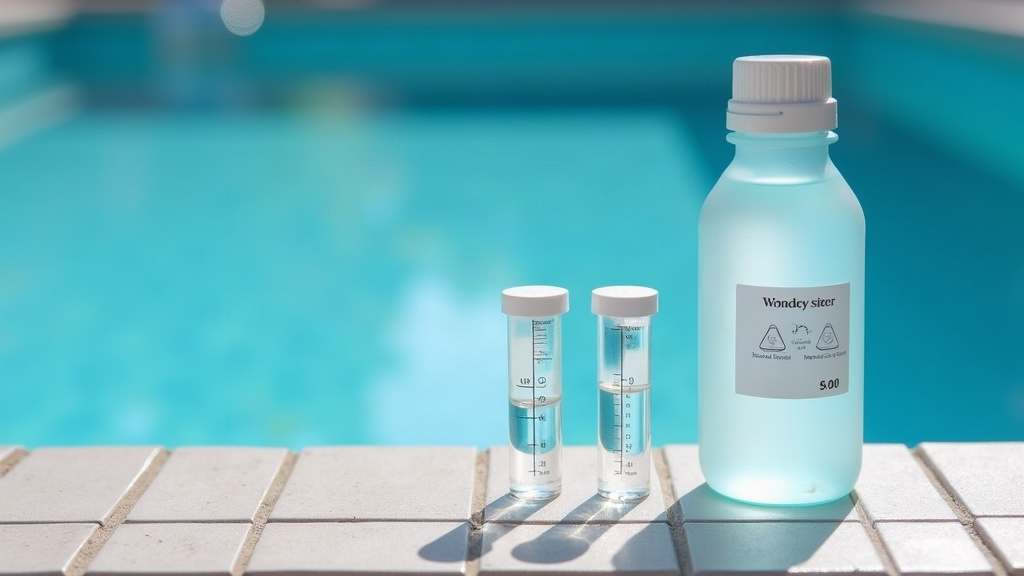
Testing before adding anything is the best way to avoid guessing, and guessing is often what leads to over-treating water with more than one product at once. A basic test covers sanitizer level, pH, and total alkalinity at minimum, and gives a clearer picture of what the water actually needs.
Comparing test strips versus liquid test kits is worth doing before assuming either method is precise enough for a given situation. Understanding what pH actually does in a pool and how it relates to total alkalinity also helps explain why an acidic product and a chlorine product are often both involved in routine maintenance — and why they still should never touch directly.
What should be done if chemicals get mixed by accident?
If a spill brings two chemicals into contact, or a fume smell develops near stored chemicals, the area should be left immediately and ventilated if it can be done safely from a distance — a door or window opened, not a person staying to fix it. Anyone affected by fumes should get to fresh air. This is a situation to treat seriously and, where there is any doubt about exposure, to get medical guidance rather than wait it out.
Afterward, cleanup and disposal of contaminated material is not a job for guesswork either. Local hazardous waste guidance, or the chemical manufacturer’s own safety documentation, is the right source for how to handle it — not a general assumption about what is “probably fine” to rinse away.
Does this apply to hot tubs as well as pools?
Yes, and arguably storage discipline matters even more in a hot tub setting, because containers are often kept in a smaller, less ventilated space close to the equipment. The chemistry itself also differs in some ways — hot tub water chemistry has its own quirks around temperature, volume, and sanitizer type, covered in how hot tub water chemistry differs from a pool. The rule on mixing chemicals directly is exactly the same regardless of which body of water they are destined for: never combine them, add one at a time, and store them apart.
Where does chemical safety fit into overall pool safety?
Chemical handling is one layer of a much bigger safety picture around a pool, and it is worth keeping in proportion. It sits alongside — not instead of — the other layers that matter: barriers and fencing, alarms, secure covers, and the most important layer of all, a designated adult actively watching the water whenever anyone is in or near it. No chemical routine, no cover, and no alarm replaces that supervision.
For a broader look at how these layers work together, what layered pool safety actually means is a useful starting point, and why supervision is still what matters most goes into that specific layer in more depth. The general safety archive at Safety covers barriers, alarms, and covers in more detail as well.
What is the simplest rule to remember about pool chemicals?
One product, one time, into a large volume of water — never into another chemical, never into a small closed space, and never guessed at without a fresh test reading. If that single habit is followed consistently, most of the risk around chemical mixing disappears on its own.
More on the everyday chemistry side of pool ownership — including chlorine types, shocking, and what specific test results actually mean — is covered across the Water Chemistry archive, and general storage and handling guidance lives in Pool Chemicals and Storage: What Owners Need to Know.
Pools Shop publishes general information, not professional advice. Pool chemicals, electrical work and structural work are genuinely hazardous and are governed by local codes that vary — use a qualified professional for anything you are not certain about, and follow the instructions on the product in front of you rather than a general guide. Nothing here is a substitute for active adult supervision around water: no cover, alarm, fence or device makes a pool safe on its own.