Most residential pools should be brushed at least once a week, and more often during hot weather, heavy use, or when algae risk is higher. Brushing loosens material that filters can’t pull off surfaces on their own, so it works alongside circulation and chemistry rather than instead of them.
How often should a pool actually be brushed?
A weekly brush is the baseline most pool owners can work from. Pools with heavier bather loads, more shade, nearby trees, or a history of algae typically need brushing two to three times a week. A pool that sits closed, uncovered, and unused for stretches can often get by with less, provided the water is still being tested and circulated.
The honest answer is that there’s no single number that fits every pool. Water temperature, sunlight, surrounding landscaping, how many people swim, and the surface material all push the right frequency up or down. Brushing is a response to conditions, not a fixed chore on a calendar.
Why does brushing matter if the pump is already circulating water?
Circulation moves water past a filter, but it doesn’t scrub anything. Algae spores, biofilm, and fine debris can settle onto walls, steps, and corners where water movement is weakest, and they can cling there even while the filter runs correctly.
Brushing knocks that material loose so it becomes suspended in the water, where the filter can actually catch it. Skipping this step means those surfaces slowly build up a layer that chemical sanitizer has to work harder to overcome. For background on how water actually moves through a pool, see how a swimming pool actually circulates water and what turnover rate means for a pool.
What parts of the pool need brushing most?
Some areas collect debris and biofilm faster than others simply because water moves through them less.
- Corners, steps, and benches, where circulation is naturally weaker
- Behind ladders, rails, and around fittings
- The waterline tile, where sunscreen, body oils, and minerals leave a visible band
- Shaded walls, especially on the north- or south-facing side depending on the pool’s orientation
- Areas near a main drain or skimmer, where flow patterns can leave dead zones nearby
A quick visual check before brushing helps target effort: if a wall feels slippery to the touch or looks slightly dull compared to the rest of the pool, that’s usually where algae is starting to establish itself.
Does pool type change how often you brush?
Yes. Surface material affects both how quickly algae can grip a wall and how much scrubbing pressure is safe to use.
Plaster and other cementitious finishes are somewhat porous and can hide algae in tiny surface irregularities, so they often benefit from a firmer brush and a consistent weekly routine. Vinyl liners are smoother but can tear or scuff under a stiff brush, so a softer brush head matters more than frequency. Fiberglass shells are the smoothest of the common finishes and tend to resist algae grip the longest, though they still need routine attention at the waterline and in corners. For a broader comparison of how these materials behave over time, see vinyl liner vs fiberglass vs concrete pools.
How does algae risk change the brushing schedule?
When conditions favor algae growth, brushing needs to happen more often, sometimes daily until the situation is under control. Warm water, heavy sun exposure, low or inconsistent sanitizer levels, and elevated phosphate levels all make algae more likely to take hold, and once it’s established it spreads faster than most owners expect.
Brushing during an algae bloom isn’t cosmetic — it’s part of getting the water back to normal, because it exposes trapped algae to sanitizer and keeps it moving toward the filter instead of resettling. For a fuller picture of what actually triggers a bloom, see what causes algae to take hold in a pool and what phosphate does in pool water.
Brushing should be paired with testing, not treated as a substitute for it. If chlorine or pH readings are off, brushing alone won’t hold algae back for long. The water chemistry section covers how the different readings interact.
What tools actually work for brushing?
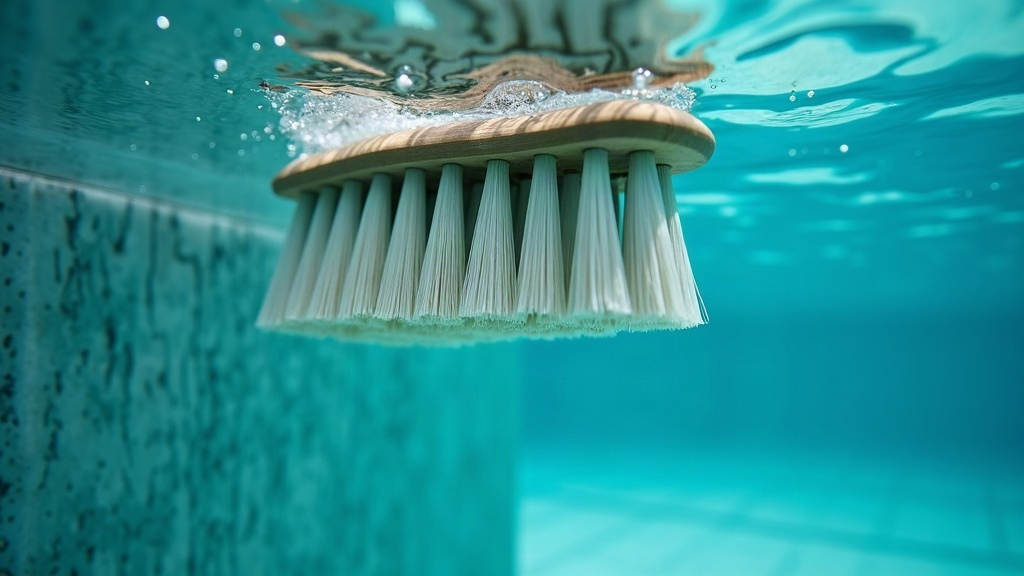
The right brush depends on the pool surface. A nylon-bristle brush is generally the safer choice for vinyl and fiberglass, since it won’t scratch a smooth finish. A stiffer bristle, sometimes with a stainless or combination head, is more commonly used on plaster and other harder finishes where algae can grip into small surface pits.
A telescopic pole long enough to reach the deep end from the deck, plus a brush head sized to the pool’s wall angles, makes the job faster and more consistent. Robotic cleaners and automatic pool cleaners can help with floor debris between brushings, but most models are not designed to scrub walls and steps the way a manual brush does, so they work best as a supplement rather than a replacement.
Does brushing replace testing and chemical maintenance?
No. Brushing is a physical step that works alongside testing and sanitizer maintenance — it doesn’t correct water chemistry, and it can’t fix a pool where chlorine is depleted or pH is out of range. A pool can be brushed thoroughly and still turn cloudy or green if the underlying chemistry isn’t being checked.
Regular testing — with either strips or a liquid kit, compared in test strips vs liquid test kits — tells an owner whether sanitizer levels are actually holding up between brushings. If chlorine keeps disappearing faster than expected, that’s worth investigating separately; see what chlorine lock is and what causes it for one common reason levels stall out. Always follow the label instructions on the specific product being used, and store pool chemicals separately from one another — never mix chlorine products with acid or other chemicals, since that combination can produce dangerous gas.
What happens if a pool is skipped on brushing for a while?
A pool that goes unbrushed for a couple of weeks usually starts showing early signs: a slightly duller finish, a faint slippery feel on walls, or the first patches of algae in shaded corners and behind ladders. Left longer, those patches spread and the water can shift toward cloudy or green even if the filter is running and chemicals look fine on paper. See why pool water goes cloudy and what actually makes pool water clear for how these signs connect back to circulation and chemistry.
Catching up after a lapse usually takes more than one session. It’s common to brush daily for a stretch, retest the water, and possibly use a shock treatment to get sanitizer levels back ahead of the demand — a step explained in what shocking a pool actually does.
A practical weekly starting point
- Brush walls, steps, and corners at least once a week in normal conditions
- Increase to two or three times a week during hot weather, heavy swimmer use, or visible algae risk
- Give the waterline extra attention, since oils and minerals build up there faster than on other surfaces
- Pair every brushing session with a water test, not just a visual check
- Treat a robotic or automatic cleaner as a floor-and-debris helper, not a wall-brushing replacement
Brushing frequency isn’t a fixed rule so much as a response to what a pool is dealing with that week. For general upkeep basics that tie into brushing, circulation, and testing together, the pool basics section is a reasonable starting point, and the pumps, filters and heaters section covers how equipment supports the work a brush does by hand.
Pools Shop publishes general information, not professional advice. Pool chemicals, electrical work and structural work are genuinely hazardous and are governed by local codes that vary — use a qualified professional for anything you are not certain about, and follow the instructions on the product in front of you rather than a general guide. Nothing here is a substitute for active adult supervision around water: no cover, alarm, fence or device makes a pool safe on its own.