Sand, cartridge and DE filters all do the same job — trapping dirt and debris so water runs clear — but they catch particles differently, need different maintenance, and cost different amounts to run and replace. Sand catches the least, DE catches the most, and cartridge sits in between with the easiest at-home upkeep.
What’s the basic difference between sand, cartridge and DE filters?
Sand filters push water through a bed of fine sand. Cartridge filters push water through a pleated fabric element. DE (diatomaceous earth) filters coat a grid with a fine powder made from fossilized shells, which acts as the actual filtering surface. Each traps progressively smaller particles as you move from sand to cartridge to DE.
The choice affects how often maintenance happens, what that maintenance involves, and how clear the water looks between cleanings. None of the three is inherently “best” — the right one depends on budget, water clarity goals and how much hands-on maintenance an owner wants to do.
How does a sand filter work?
A sand filter is a sealed tank filled with graded sand. Water enters at the top, filters down through the sand bed, and exits through a system of laterals near the bottom. Trapped dirt stays lodged in the sand until it’s flushed out.
Cleaning a sand filter means backwashing: reversing the flow of water through the tank and sending the dirty water out to waste. It’s a quick process, usually done with a multiport valve, and doesn’t involve opening the tank or touching the media directly.
- Catches the largest particle size of the three filter types
- Cheapest to buy and generally the least involved to maintain
- Sand inside eventually needs replacing as it wears down and loses its texture, though how long that takes varies by usage and water conditions
For a full explanation of what backwashing actually does to the water and the media, see what backwashing a filter does.
How does a cartridge filter work?
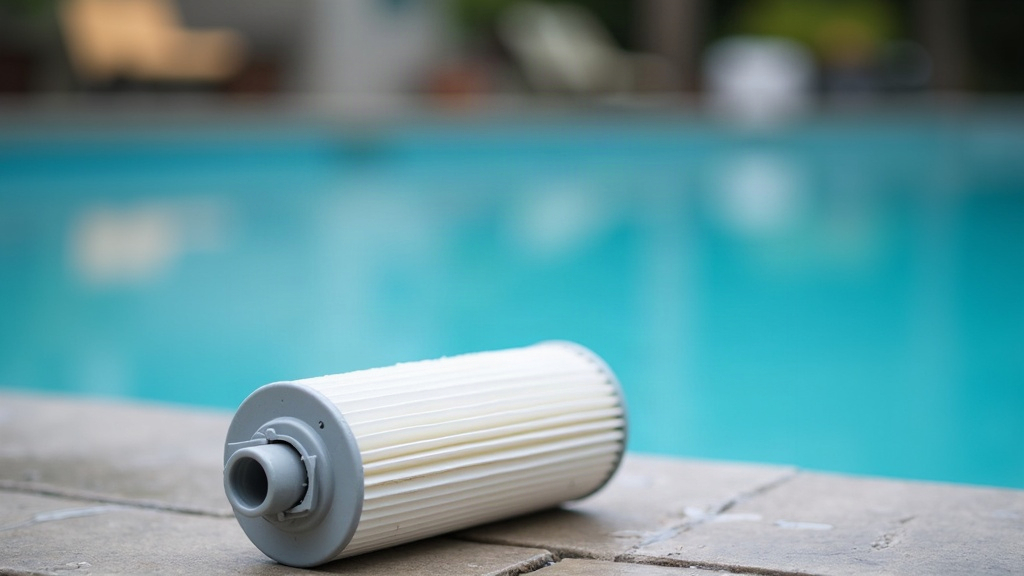
A cartridge filter uses one or more pleated fabric elements housed inside a canister. Water passes through the pleats, which trap debris on the surface of the fabric. There’s no backwashing involved — the cartridge is removed, hosed off, and put back.
Because the pleats create a lot of surface area in a compact space, cartridge filters generally run at lower pressure than sand filters of similar size, which can mean less strain on the pump.
- Catches finer particles than sand
- Cleaning is manual — pulling the cartridge and hosing it down periodically
- Cartridges need periodic deep-cleaning or soaking beyond a simple hose-off, and eventually replacement when the fabric degrades or won’t come clean
- No backwash water is sent to waste, which some owners prefer where water conservation or drainage rules matter
The difference between a routine hose-off and a job that calls for a proper soak or cleaning solution is explained in when a filter needs cleaning rather than backwashing.
How does a DE filter work?
A DE filter uses grids or fingers coated in diatomaceous earth powder, a fine, chalky material made from fossilized diatoms. The DE itself is what does the filtering — the grids are just the structure the powder clings to. Water passing through the coated grids leaves behind even the smallest particles.
DE filters are typically backwashed similarly to sand filters, and then fresh DE powder is added back into the system afterward through the skimmer. The tank itself may also need to be opened periodically to inspect and clean the grids directly.
- Catches the finest particle size of the three, often producing the clearest-looking water
- Requires periodically adding fresh DE powder after backwashing
- Generally the most involved and priciest option to run over time
- Local rules may restrict how DE backwash water can be discharged, since the powder itself is a fine particulate — check local code before assuming it can go straight to a storm drain
Which filter type is cheapest to run?
Sand filters are usually cheapest up front and simplest to maintain, but they use more backwash water and don’t polish water quite as finely. Cartridge filters cost more initially but skip backwash water and are easy for an owner to manage directly. DE filters tend to cost the most over time, factoring in the ongoing powder.
None of these costs can be quoted as a fixed number — they depend on local water and disposal rules, the size of the pool, how hard the filter works given the pool’s bather load, and regional pricing for replacement media or cartridges. What drives the cost is mostly how often maintenance happens and what media or parts need replacing when it does. For a broader look at what affects pool running costs generally, the Buying & Costs section covers related ground.
Which filter type is easiest to maintain?
Cartridge filters are generally considered the easiest for a hands-on owner, since cleaning just means rinsing the cartridge with a hose — no backwashing, no adding powder. Sand filters are close behind since backwashing is quick, even if it uses more water. DE filters take the most steps.
Whichever type is installed, the underlying signal for cleaning is the same: rising pressure on the filter’s gauge above its normal running level. That’s covered in more depth in when a filter needs cleaning rather than backwashing and what backwashing a filter does.
How do I tell which filter type my pool already has?
Look at the equipment pad. A sand filter is usually a large, plain tank — often fiberglass or a similar composite — with a multiport valve on top with a handle for backwash, filter, rinse and waste settings. A cartridge filter is typically a slimmer canister with a lid that unclamps for cartridge access. A DE filter often looks similar to a sand tank but usually has a manifold on top for backwashing and a port for adding DE powder.
If the equipment pad layout is unfamiliar generally, what’s on a pool equipment pad walks through the typical parts and where they sit relative to each other.
Does the filter type affect water chemistry?
Filter type doesn’t change what chemicals are needed or how sanitizer works — that’s governed by testing and dosing decisions covered in the Water Chemistry section. But a filter that isn’t cleaned on schedule, regardless of type, lets particles recirculate rather than getting trapped, which shows up as cloudy water even when chemistry looks fine on paper.
Cloudiness with a filter that seems to be running normally is worth chasing down separately — see why pool water goes cloudy and what actually makes pool water clear for the fuller picture of causes beyond the filter itself.
Does the filter affect turnover rate?
The filter’s size and condition play a role in how effectively a pool’s water gets fully circulated and filtered over a given period, known as turnover rate. A clogged filter of any type, sand, cartridge or DE, restricts flow and slows that process down regardless of how well-suited the filter is to the pool otherwise.
For more on why turnover rate matters and how it ties to pump run time, see what turnover rate is and why it matters and why a pool needs daily circulation.
Can I switch from one filter type to another?
Swapping filter types on an existing pool is possible in many cases, but it usually involves plumbing changes at the equipment pad and sometimes electrical considerations if pump sizing changes too. That kind of work sits with a licensed pool professional rather than being a weekend DIY swap, since incorrect plumbing or electrical connections near pool equipment carry real safety risk.
Anyone considering a switch should ask a licensed installer about compatibility with the existing pump, the plumbing runs already in place, and any local permit requirements tied to equipment changes. For related basics on how pumps and filters work together, see what a pool pump actually does and the Pumps, Filters & Heaters hub.
Which filter type should a new pool owner choose?
There’s no single right answer — it depends on budget, tolerance for hands-on maintenance, and how strict local rules are around backwash water disposal. A sand filter suits owners who want the simplest, lowest-maintenance option and don’t mind slightly less fine filtration. A cartridge filter suits owners comfortable doing periodic manual cleaning in exchange for no backwash water waste. A DE filter suits owners prioritizing the clearest possible water and willing to manage the extra steps that come with it.
New pool owners weighing this alongside other build decisions, like shell material, may find it useful to read vinyl liner vs fiberglass vs concrete pool differences and the broader Pool Basics and Cleaning & Maintenance hubs for how equipment choices fit into everyday upkeep.
Pools Shop publishes general information, not professional advice. Pool chemicals, electrical work and structural work are genuinely hazardous and are governed by local codes that vary — use a qualified professional for anything you are not certain about, and follow the instructions on the product in front of you rather than a general guide. Nothing here is a substitute for active adult supervision around water: no cover, alarm, fence or device makes a pool safe on its own.