A cartridge typically lasts somewhere between one and several swim seasons, not a fixed number of months. The real driver is how much debris and fine particulate it processes and how well it’s rinsed clean between uses — a heavily used pool with poor water balance wears cartridges out far faster than a lightly used one.
What actually shortens a cartridge’s life?
Cartridge life is worn down by what passes through it, not by the calendar. A cartridge in a pool with high bather load, frequent algae blooms, or poor water balance will clog and degrade faster than one in a clean, well-maintained pool used occasionally.
- Sunscreen, body oils and cosmetics that coat the pleats
- Fine algae particles after a bloom, which are hard to rinse fully out of the fabric
- Repeated exposure to water with unbalanced pH or sanitizer levels
- Physical damage from rough handling during cleaning
- Running the pump for long hours without the filter ever being rinsed
Because these factors vary so much from pool to pool, nobody can honestly hand over a single lifespan figure that applies to every cartridge. What can be described is the pattern of decline to watch for.
How can you tell a cartridge is nearing the end of its life?
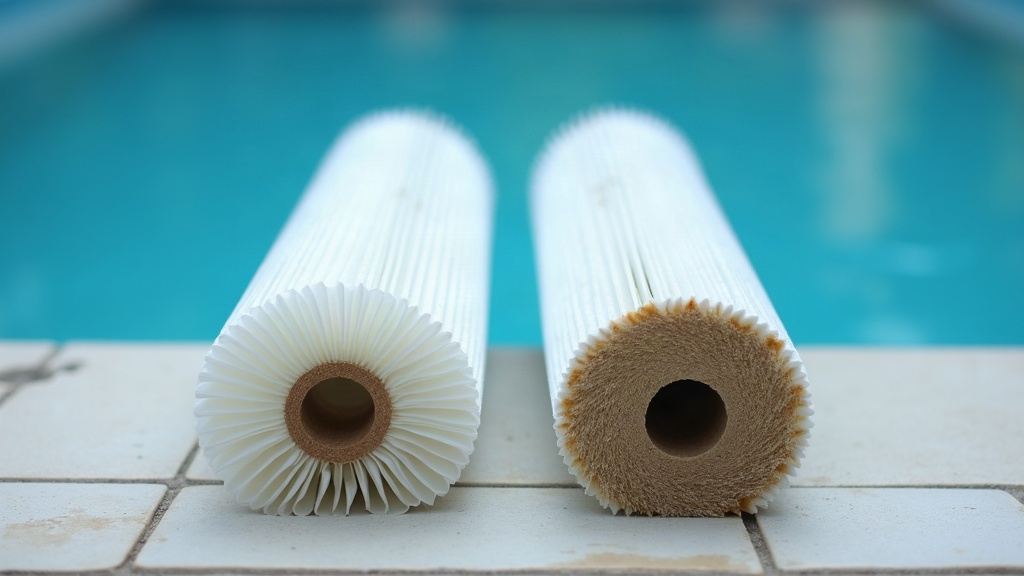
A cartridge is wearing out when it needs cleaning more and more often, when pressure climbs quickly after a fresh clean, or when the pleats look permanently discolored, thinned, or torn even after a thorough rinse.
A new or healthy cartridge holds its pleats tightly and returns close to baseline pressure after cleaning. As it ages, that baseline creeps upward — the filter is doing less work for the same flow, and the pump has to push harder. If a cartridge that used to run for weeks between cleanings suddenly needs attention every few days, that’s a sign the media itself has degraded rather than just gotten dirty.
Torn pleats, sagging fabric that no longer holds its shape, or a strong musty odor that rinsing does not remove are all signs the cartridge is due for replacement rather than another cleaning cycle. For a closer look at the difference between routine cleaning and a filter that’s actually reached the end of the road, see when a filter needs cleaning rather than backwashing.
Does cleaning a cartridge extend its life?
Yes — regular rinsing removes the debris that clogs pores and encourages fabric breakdown, and it’s the single biggest factor an owner controls. A cartridge that’s rinsed on a sensible schedule generally lasts longer than one left to run until pressure spikes.
Routine care includes hosing the cartridge down between the pleats to knock loose debris, and giving it a soak in a cartridge cleaning solution designed for the purpose when it’s visibly dirty or oily. Skipping this step and simply waiting for pressure to climb lets fine material embed deeper into the fabric each time, which is harder to remove and speeds up wear. Details on what a normal cleaning routine involves are covered in what backwashing a filter actually does, though cartridge filters are cleaned differently from sand or DE systems — worth understanding if switching between filter types is ever on the table, which is explained in sand vs cartridge vs DE filters.
What role does water chemistry play in cartridge wear?
Water that’s out of balance makes a cartridge work harder and can accelerate fabric breakdown. Algae, scaling minerals and organic contaminants all load extra material into the filter that a well-balanced pool would never produce in the same quantity.
A pool that swings in and out of algae growth puts a cartridge through repeated heavy-debris events, each one leaving behind particles that rinsing alone may not fully clear. Keeping sanitizer and pH within range, and staying ahead of the conditions that let algae take hold, reduces how often the cartridge faces that kind of load. Background on what tips a pool toward algae growth is covered in what causes algae to take hold in a pool, and general water balance guidance lives in the water chemistry hub.
Scale buildup from hard water can also coat the pleats with a hard, chalky layer that’s difficult to rinse away. If calcium levels tend to run high, that’s worth checking separately — see why calcium hardness matters.
Does pump run time affect cartridge life?
Longer daily run times mean more total water — and more debris — passing through the cartridge, which can mean more frequent cleanings even if each individual cleaning is straightforward. Run time itself doesn’t damage the cartridge, but it does determine how quickly it accumulates load.
Turnover rate, which is how often the pool’s full volume passes through the filter, is set by pump run time and affects how hard the cartridge works day to day. A pool that circulates properly and consistently tends to spread the filtering load more evenly than one that’s run in short, inconsistent bursts. More on how that’s calculated is in what turnover rate is and why it matters, and on why consistent circulation matters generally in why a pool needs daily circulation.
How is a cartridge different from other filter media in terms of wear?
Cartridge media is a physical fabric that degrades permanently over time, unlike sand or DE grid media, which can often be refreshed with backwashing or recharging. Once a cartridge’s fabric has thinned, torn, or lost its ability to trap fine particles, no amount of cleaning restores it.
This is one of the practical trade-offs between filter types. Cartridge systems generally involve less routine water loss than sand filters (no backwash cycle flushing water down the drain), but the media itself is a wearing part that eventually needs full replacement rather than recharging. The comparison of how each filter type behaves over its working life is laid out in the filter type comparison.
What should be checked before buying a replacement cartridge?
The replacement needs to match the housing’s size and pleat configuration exactly — a cartridge that’s the wrong dimensions won’t seal properly and can let unfiltered water bypass the media entirely. The existing cartridge’s model information, or the housing’s own documentation, is the reliable reference point.
Because pricing and availability for cartridges vary widely by size, brand and region, this isn’t a place to expect one figure to apply everywhere. What drives the cost is largely the surface area of pleated media and how specialized the housing is. General guidance on budgeting for pool equipment and knowing what’s worth spending more on lives in the buying & costs hub.
If a cartridge is being replaced, it’s also a reasonable moment to check the rest of the equipment it sits alongside — pressure gauge, valves, and the pump itself — since a struggling pump or a stuck valve can mimic the symptoms of a failing cartridge. An overview of what typically sits on an equipment pad is in what a pool equipment pad is, and how the pump interacts with the filter is covered in what a pool pump actually does.
Can a cartridge be stored or reused between seasons?
A cartridge that’s cleaned thoroughly and dried properly before storage can often be reinstalled the following season, provided it isn’t already showing signs of wear. Storing it wet, folded, or in direct sun tends to shorten its usable life further.
Between-season storage is also a reasonable time to inspect pleats closely for tearing or permanent staining that cleaning didn’t remove — catching that now avoids a surprise pressure problem when the pool reopens. For broader seasonal equipment care, the pumps, filters & heaters hub and the cleaning & maintenance hub cover routines that keep filtration equipment working reliably across the year.
The bottom line
There’s no single honest number for how long a filter cartridge lasts — it depends on bather load, water balance, run time and how consistently it’s cleaned. Watching for rising pressure, slower cleaning recovery, and visible wear in the pleats is a more reliable guide than counting months on a calendar.
Pools Shop publishes general information, not professional advice. Pool chemicals, electrical work and structural work are genuinely hazardous and are governed by local codes that vary — use a qualified professional for anything you are not certain about, and follow the instructions on the product in front of you rather than a general guide. Nothing here is a substitute for active adult supervision around water: no cover, alarm, fence or device makes a pool safe on its own.