Most pool pumps run well for roughly a decade before the motor wears out, though heavy use, poor maintenance or a harsh climate can shorten that considerably. Filters usually last longer structurally, but their internal media — cartridges, sand or grids — need replacing on a separate, shorter cycle.
How long does a pool pump typically last?
A well-maintained pump often runs for somewhere in the neighborhood of eight to twelve years before the motor bearings or seals fail beyond repair. That range is not a guarantee — some pumps fail earlier, some keep going longer — because so much depends on run time, water chemistry and how quickly small problems get noticed.
The motor is usually what limits life, not the pump housing or impeller, which can often be serviced or swapped. Once a motor seal starts leaking or bearings get noisy, most owners find replacement is more practical than repeated repair. For a rundown of what those early warning signs look like, see how you know a pool pump is failing.
How long does a pool filter typically last?
The filter tank itself — the housing that holds the media — can often outlast several pumps if it isn’t cracked, warped by heat or damaged by chemical exposure. What wears out faster is the media inside it: cartridges, sand or DE grids all have their own shorter replacement cycles.
Cartridges are the part owners replace most often, and how long one lasts depends heavily on bather load, debris and how often it gets cleaned. There’s a full breakdown at how long filter cartridges last. Sand media is typically changed on a much longer cycle, while DE grids are inspected and cleaned more like cartridges. The type of filter installed changes this math considerably — see sand vs cartridge vs DE filters for how the three compare.
What makes a pump wear out sooner?
Pumps age faster when they run more hours than they need to, when they’re forced to work against unnecessary resistance, or when small issues go unaddressed long enough to stress the motor.
- Running longer than the pool’s actual turnover needs, which adds hours without adding benefit
- Fighting excess resistance from a clogged skimmer basket, dirty filter or closed valve — a concept covered in what pump head means and why it matters
- Repeated loss of prime, which can run a pump dry and damage the seal — see what causes a pool pump to lose prime
- Exposure to freezing temperatures without proper winterizing, or constant sun and moisture at an exposed equipment pad
- Electrical issues such as voltage fluctuations or a failing capacitor, which is licensed electrical work to diagnose and correct, not a DIY repair
What makes a filter wear out sooner?
Filter media clogs and degrades faster when water chemistry is out of balance, when the pool collects heavy debris, or when cleaning is skipped until pressure climbs too high.
Cartridges pick up oils, sunscreen residue and fine debris that ordinary rinsing doesn’t fully remove over time, which is why they eventually need chemical cleaning or replacement rather than just a hose-down. Sand can channel or compact, losing its ability to trap fine particles even though it looks unchanged. Knowing the difference between routine backwashing and an actual deep clean matters here — compare what backwashing actually does with when a filter needs cleaning, not backwashing.
Water chemistry plays a bigger role than most owners expect. Scale buildup from unbalanced calcium levels can coat media and internal parts — see what scale is and why it forms — while heavy phosphate loads or algae blooms overload a filter far faster than clean water ever would.
What are the signs a pump or filter is nearing the end?
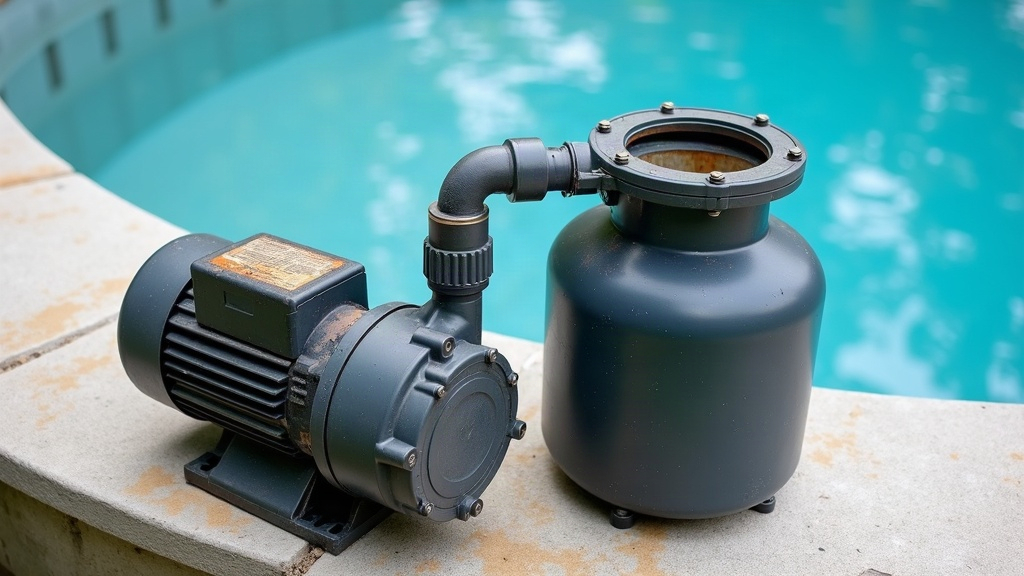
Rising noise, falling water flow, and pressure readings that climb faster than they used to are the clearest signals that a pump or filter is approaching the end of its useful life.
- A pump that’s noticeably louder, grinding, or humming without spinning
- Visible leaks around the pump seal or unions, even small drips
- Reduced flow to jets and returns despite a clean filter and clear skimmer basket
- A filter pressure gauge that reads high right after cleaning, or climbs unusually fast — explained further at what a filter pressure gauge actually tells you
- Cracks, warping or brittle fittings on the filter tank itself
None of these signs mean the equipment has to be replaced immediately, but they’re worth investigating before a small issue becomes a bigger one.
Does the type of pump change how long it lasts?
Variable speed pumps often run more total hours than single-speed pumps because they’re designed to operate at low speed for most of the day, but they typically use less energy and run cooler doing it, which can be easier on internal components.
Single-speed pumps run at one output whenever they’re on, cycling on and off instead of ramping down, which can mean more strain during each start-up. The tradeoffs between the two are covered in what a variable speed pump is and why it’s now standard, and the energy angle is explained at why a pool pump is the biggest energy user in a pool.
When is repair worth it, and when is replacement better?
A leaking seal, worn bearing or failed capacitor can often be repaired on an otherwise sound pump, especially early in its life. Once the motor itself is failing, or repairs start adding up close to the cost of a new unit, replacement usually makes more sense.
Any work involving wiring, bonding or grounding at the equipment pad is licensed electrical work, not a weekend project — a qualified electrician or licensed pool professional should handle connections, motor swaps that involve rewiring, and anything touching the electrical panel. For background on what typically sits at that pad, see what a pool equipment pad is and what’s on it. Filters are more often a straightforward media or cartridge swap, though a cracked tank or damaged multiport valve is a job worth getting a professional opinion on before buying parts.
How does maintenance stretch the life of pumps and filters?
Consistent, basic maintenance is the single biggest factor an owner actually controls. Balanced water chemistry, a clear skimmer basket, and a filter that’s cleaned on schedule all reduce the strain equipment deals with every day.
- Keeping pH, alkalinity and calcium in range to limit scale — background at why calcium hardness matters
- Clearing leaves and debris before they reach the pump basket, as covered in dealing with pool leaves without wrecking the equipment
- Understanding turnover so the pump isn’t running longer than the pool actually needs — see what turnover rate is and why it matters
- Cleaning or backwashing the filter before pressure climbs too far above its baseline
None of this guarantees a specific lifespan, since site conditions, run time and water quality all vary. But steady, unglamorous maintenance is what consistently separates equipment that lasts toward the long end of its range from equipment that fails early. For broader guidance on keeping the rest of the system running smoothly, the Pumps, Filters & Heaters and Cleaning & Maintenance archives cover related upkeep in more depth, and anyone budgeting for an eventual replacement may find the Buying & Costs section useful for understanding what drives those decisions.
Pools Shop publishes general information, not professional advice. Pool chemicals, electrical work and structural work are genuinely hazardous and are governed by local codes that vary — use a qualified professional for anything you are not certain about, and follow the instructions on the product in front of you rather than a general guide. Nothing here is a substitute for active adult supervision around water: no cover, alarm, fence or device makes a pool safe on its own.