The safest way to deal with leaves is to remove them before they sink or break apart, not after. Skim the surface daily during heavy drop, empty baskets often, and let a robotic or pressure cleaner handle what’s already on the bottom — running everything through the main pump and cartridge filter is what actually strains equipment.
Why do leaves cause problems in the first place?
Leaves that sit in water start to break down. Tannins leach out and can tint the water, and decomposing organic matter is exactly the kind of debris that feeds algae and consumes sanitizer. Whole leaves are manageable; leaf mush is not.
The equipment risk is separate but related. A pool pump and filter are designed to handle fine dirt and small particles, not a season’s worth of whole leaves pulled in bulk through a skimmer throat or a suction cleaner hose.
Should leaves be netted out or left for the skimmer to catch?
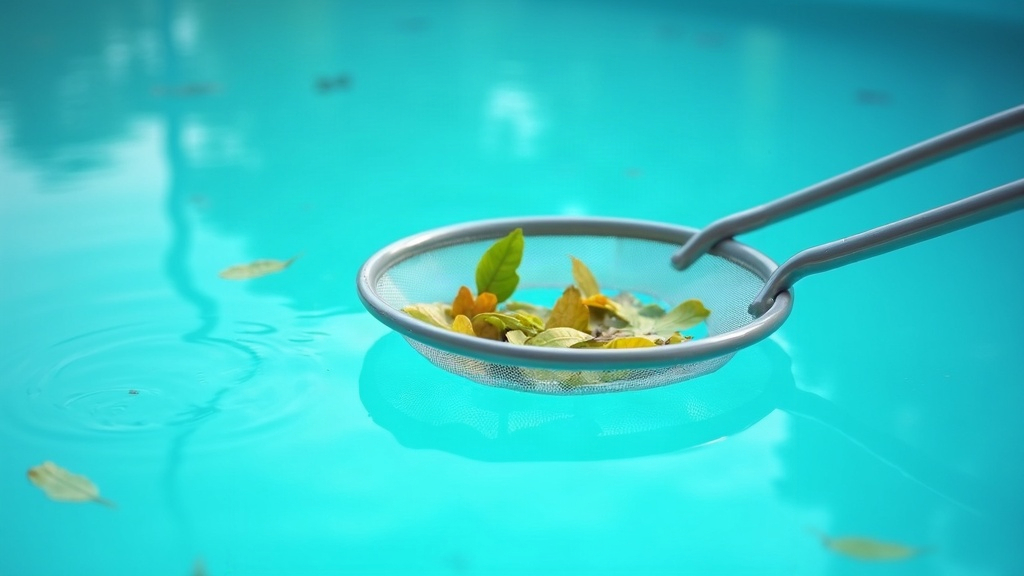
Netting leaves off the surface by hand, before they sink, is easier on the equipment than relying on the skimmer alone. A hand net catches leaves whole and keeps them out of the plumbing entirely, which reduces basket clogging and filter loading.
The skimmer is still doing useful work between manual passes — it’s worth understanding how a skimmer differs from the main drain and why most surface debris is meant to travel through it rather than the drain at the bottom.
- Skim in the morning before wind and swimmers stir leaves under the surface.
- Use a flat, fine-mesh net rather than a deep bag net for wet leaves — it lets water drain through faster.
- Empty the skimmer basket every time it’s more than half full, not just on a schedule.
Can leaves actually damage a pump or filter?
A large volume of leaves pulled into a skimmer basket, pump strainer basket, or cartridge filter can restrict flow, and restricted flow is what stresses the whole system — not the leaves sitting harmlessly in a basket.
Reduced flow makes a pump work harder against resistance, and it can shorten how long a filter runs comfortably between cleanings. Cartridge filters in particular clog faster when fine leaf debris gets past the basket, and what actually wears a cartridge out is repeated heavy loading like this, not just age.
Checking the pressure gauge on the filter regularly during leaf season is a simple habit — a rising reading compared to a clean-filter baseline is the clearest sign flow is being restricted.
Does a robotic or pressure cleaner handle leaves better than a suction cleaner?
Robotic cleaners generally handle heavy leaf loads better because they have their own independent filter bag or cartridge and don’t rely on the pool’s main pump and filter to trap what they pick up. Suction cleaners send debris straight into the pool’s own filter, which fills it faster.
The real difference between suction, pressure, and robotic cleaners comes down to where the debris ends up. A robotic unit’s onboard filter can simply be emptied and rinsed, which is far less disruptive than an overloaded main filter needing a full clean.
It’s worth knowing what a robotic cleaner is actually doing before assuming it will keep up unattended through a heavy leaf drop — most models still need their basket emptied more often than usual in that season, and none of them replace checking the pool by eye.
What if leaves are left to sit and rot in the water?
Left alone, leaves sink, break down, and release organic material that clouds water and gives algae something to feed on. Tannins can also stain plaster or liner surfaces, particularly near the waterline, and heavy debris load makes the sanitizer work harder just to keep up.
This connects to broader water chemistry, not just cleanliness. What actually lets algae take hold often includes exactly this kind of decaying organic debris combined with sanitizer that’s been outpaced. If the water starts to look hazy or dull, it’s also worth reading why pool water goes cloudy, since leaf litter is one of several common causes.
Rotting leaves and the resulting plant matter can also contribute to phosphate levels, which is covered in more detail in what phosphate is in pool water and whether it matters. None of this is a reason to guess at chemical additions — test the water with a reliable kit and follow the product label in front of you for anything used to correct it.
How often should the pool be brushed during a heavy leaf drop?
More often than usual. Brushing loosens debris and any early buildup on walls and steps before it settles into a stain, and it’s a useful companion to skimming rather than a replacement for it.
General guidance on frequency is covered in how often a pool should actually be brushed — during a heavy drop, brushing corners and steps where leaves collect is worth doing more regularly than the routine schedule suggests.
Are leaf nets or covers worth using in fall?
A dedicated leaf net stretched over the pool during peak drop can keep the bulk of debris off the water entirely, which is far less work than fishing leaves out daily. It sits on top of the water rather than sealing it, so it is a maintenance tool, not a safety barrier.
Leaf nets and winter covers are not childproofing and were never designed to be. If there’s any chance of a child or pet reaching the pool area while a net or cover is on, the only reliable layer is a designated adult actively watching — nets, covers, alarms and fencing all work together, and none of them substitutes for supervision. Local rules about barriers and covers vary, so check local code and permit requirements before assuming any product meets a legal safety standard.
Does leaf debris affect the equipment pad itself?
Leaves piling up around the equipment pad — not in the water, but on the ground near the pump, filter, and heater — can block airflow, clog drainage, and make routine checks harder. Keeping the area around the pad clear is a simple habit that protects the equipment as much as anything done in the water.
For a refresher on what’s actually sitting on that pad and why each piece matters, see what a pool equipment pad is and what’s on it. Any electrical work near that pad — new wiring, bonding, or grounding — is licensed trade work, not a weekend project, and any concerns about it are worth raising with a licensed electrician rather than guessing.
What’s the simplest leaf routine to stick to?
A short daily routine during peak drop prevents almost all of the downstream problems leaves cause. It takes a few extra minutes and saves considerably more time later.
- Skim the surface by hand before running the pump for the day.
- Empty the skimmer basket and check the pump strainer basket.
- Run a robotic cleaner for bottom debris rather than a suction cleaner, if one is available.
- Check the filter pressure gauge and clean or backwash if it’s climbed.
- Brush corners and steps where leaf debris tends to collect.
For broader upkeep beyond leaf season, the cleaning and maintenance archive covers routine tasks in more depth, and the pumps, filters and heaters archive is useful background on how the equipment being protected actually works.
Pools Shop publishes general information, not professional advice. Pool chemicals, electrical work and structural work are genuinely hazardous and are governed by local codes that vary — use a qualified professional for anything you are not certain about, and follow the instructions on the product in front of you rather than a general guide. Nothing here is a substitute for active adult supervision around water: no cover, alarm, fence or device makes a pool safe on its own.