Clear pool water comes from three things working together: filtration that physically removes particles, circulation that moves every gallon past that filter regularly, and balanced chemistry that keeps contaminants dissolved or destroyed instead of clouding the water. Skip any one of the three and the water dulls, no matter how much chlorine gets added.
Why doesn’t chlorine alone make water clear?
Chlorine’s job is sanitizing — killing bacteria and oxidizing organic waste like sweat, oils, and sunscreen. It does very little to remove the fine particles that make water look hazy. Clarity is a filtration and circulation job first, a chemistry job second.
A pool can have textbook-perfect sanitizer levels and still look dull if the water isn’t physically passing through a filter often enough to strain out what’s suspended in it. That’s why a cloudy pool with “good” chemical readings is one of the more confusing problems owners run into — the fix usually isn’t more chemical, it’s more turnover.
What role does filtration play in clarity?
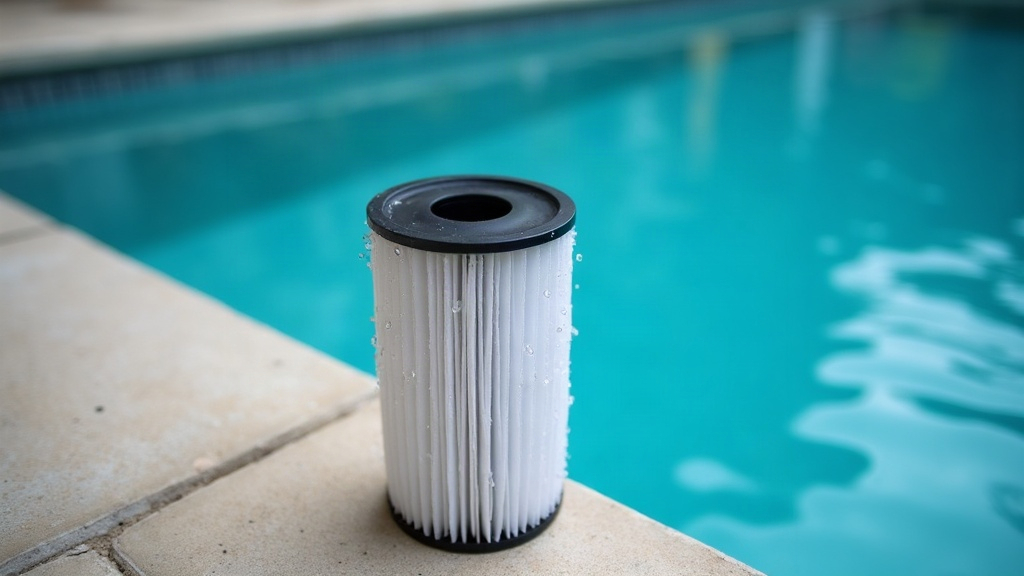
Filtration is the mechanical part of clarity: water is pulled through a filter medium — sand, a cartridge, or a diatomaceous earth grid — that physically traps particles too small to settle out on their own. The finer the medium, the smaller the particles it can catch.
Different filter types trap different particle sizes, and each has its own cleaning routine and maintenance rhythm. None of them work if the water bypasses them or if the pump isn’t moving enough volume through the system. For a walk-through of the equipment involved, see what a pool equipment pad actually contains, and the broader pumps, filters and heaters archive covers how each filter type behaves over time.
Why does circulation matter as much as filtration?
A filter can only clean water that reaches it. Circulation is what moves water from every part of the pool — the deep end, the corners, under ladders — back toward the skimmer and drain and through the filter. Dead zones with poor circulation stay cloudier and collect debris longer than the rest of the pool.
This is measured loosely by turnover rate: roughly how long it takes the pump and filter to cycle the entire pool volume. A pool that technically “runs” for a short time each day but never achieves a full turnover will often struggle with clarity even with clean equipment. The concept is explained in more detail in what turnover rate is and why it matters, and in why a pool needs to be circulated every day.
The pump itself is the engine behind all of this — it doesn’t clean water directly, it moves it. A closer look at what a pool pump actually does explains why an undersized or poorly-run pump undermines everything downstream of it, and how a pool actually circulates water walks through the full loop from skimmer to return jets.
How does water balance affect clarity?
Water balance affects clarity because minerals and chemicals behave differently depending on pH, alkalinity and calcium levels. Water that’s out of balance can turn cloudy from dissolved minerals precipitating out, or can make sanitizers work far less effectively, letting organic waste build up.
This is why testing matters more than guessing. A basic test kit or test strips check pH, sanitizer level, and total alkalinity at minimum; more complete kits also check calcium hardness and stabilizer. None of these numbers can be estimated safely from an article — the right adjustment depends on the pool’s actual volume, the current reading, and the specific product on hand. Always follow the dosing instructions printed on the product’s own label rather than a general rule of thumb.
Chemical storage deserves its own caution here: sanitizing products and pH-adjusting acids should always be stored separately and never combined directly, since mixing chlorine-based products with acid can produce dangerous gas. Keeping containers apart on the shelf is a simple habit that avoids a real hazard.
The water chemistry archive goes deeper into how each of these readings interacts with the others.
What causes cloudy water even when chemistry looks fine?
Cloudy water with balanced chemistry usually points to a physical cause: a dirty filter that needs cleaning, a pump not running long enough each day, a clogged skimmer basket restricting flow, or extremely fine particles (like sunscreen residue or very fine dust) that the filter medium isn’t rated to catch.
- A filter overdue for cleaning or backwashing loses much of its trapping ability.
- Low water level can starve the skimmer of flow, reducing how much surface water actually reaches the filter.
- A pump running short cycles may never achieve a full turnover in a day.
- Heavy bather load or a recent storm can introduce more particulate than the system is used to handling.
The skimmer and main drain pull from different points in the pool and both matter for clarity — a pool relying too heavily on one over the other can leave whole sections poorly circulated. The difference is explained in skimmer vs. main drain: what’s the real difference. For a fuller diagnostic walk-through of murky water specifically, see why pool water goes cloudy.
How often should water actually be tested?
Most home pools benefit from testing sanitizer and pH levels every few days during swim season, and more often after heavy rain, a pool party, or any noticeable change in the water’s appearance. Testing more frequently costs little and catches imbalance before it turns into cloudiness or scaling.
Keeping a simple log of readings over a season also makes it easier to spot patterns — for instance, whether clarity issues tend to follow certain weather or usage patterns rather than appearing at random.
Does losing water affect clarity?
Not directly, but a pool that’s steadily losing water can end up with a lower water level than the skimmer is designed for, which reduces flow into the filter and hurts circulation. If clarity problems show up alongside water loss, it’s worth ruling out a leak rather than assuming the two are unrelated.
Normal evaporation and an actual leak look similar at first glance but behave differently over time; the comparison in evaporation vs. a real pool leak and the explanation of why pools lose water even with no leak both help separate ordinary water loss from something that needs attention.
When is cloudy water a bigger problem?
Water that stays cloudy for more than a day or two despite normal filtration, circulation and balanced test readings is worth investigating further rather than just adding more sanitizer. Persistent cloudiness can also make it harder to see the pool floor clearly, which matters for anyone supervising swimmers.
That last point deserves emphasis: clear water is partly a safety issue, not just an appearance one. Being able to see the bottom of the pool at all times helps a watching adult spot trouble immediately. No cover, alarm, fence or filter system replaces a designated adult actively watching the water whenever anyone — especially a child — is in or near the pool. Clarity supports that supervision; it never substitutes for it.
What’s the simplest way to think about pool clarity?
Clarity is the visible result of three systems doing their job at the same time: a filter fine enough and clean enough to trap particles, a pump and circulation pattern strong enough to bring water to that filter regularly, and chemistry balanced enough to keep the water itself stable. When water turns cloudy, the most useful question isn’t “what chemical is missing” — it’s which of those three systems is falling short.
Owners weighing a new build or a major equipment upgrade often find that pool type affects how easily water stays clear too; liner material and surface texture influence how algae and debris cling to pool walls, a topic covered in vinyl liner vs. fiberglass vs. concrete pools. For anyone still assembling the basics of how a pool’s systems fit together, the pool basics archive and buying and costs archive are good starting points before making equipment decisions.
Pools Shop publishes general information, not professional advice. Pool chemicals, electrical work and structural work are genuinely hazardous and are governed by local codes that vary — use a qualified professional for anything you are not certain about, and follow the instructions on the product in front of you rather than a general guide. Nothing here is a substitute for active adult supervision around water: no cover, alarm, fence or device makes a pool safe on its own.