A ring at the waterline forms because oils from skin, sunscreen, lotion, hair products and airborne dust don’t dissolve in water. They float, collect at the surface where the water meets the tile or liner, and stick there as the water level rises and falls slightly. Over time this thin film darkens and hardens into a visible band.
Why does the ring form right at the waterline and nowhere else?
The waterline is where the water’s surface constantly touches the same strip of tile, liner or fiberglass. Anything floating on top — oil, lotion residue, sunscreen, pollen, dust — gets pushed against that edge by wind and circulation and left behind as a thin film. Because the same strip gets coated day after day, the residue builds instead of spreading out.
What is the ring actually made of?
It’s usually a mix of organic oils and fine mineral particles rather than one single substance. Common contributors include:
- Body oils, sunscreen and lotion residue left by swimmers
- Dust, pollen and airborne debris that settle on the water surface
- Fine particles of dirt tracked in on feet and pool toys
- Mineral scale, especially where water is on the hard side
The greasy component is what makes the ring feel slightly slick or waxy to the touch, while the mineral part is what makes it feel gritty or rough, especially on plaster or exposed tile grout.
Does sunscreen and body oil really matter that much?
Yes — it’s usually the single biggest contributor. Sunscreen and lotion are formulated to resist water, which is exactly why they float rather than mix in, and why they cling to the first solid surface they touch, which is the tile at the waterline.
A rinse-off shower before swimming reduces how much lotion and oil ends up in the water in the first place, though it won’t eliminate the ring entirely since dust and skin oils are unavoidable in any pool that gets used.
Does hard water make the ring worse?
Water that is high in calcium hardness is more likely to leave a scaly, rough waterline deposit in addition to the oily film. Calcium doesn’t stay perfectly dissolved when hardness runs high, and the waterline is one of the first places it shows up as a visible crust rather than in the bulk water. Understanding why calcium hardness matters helps explain why some pools develop a rough, chalky ring while others get a mostly greasy one.
Do phosphates and algae play a role?
Phosphates themselves don’t stain tile, but they’re a nutrient source that can encourage algae growth, and a waterline that already has an oily film is an easier place for algae and biofilm to gain a foothold. Readers curious about that connection can look at what phosphate in pool water actually does and what causes algae to take hold in a pool.
Does low chlorine make the ring show up faster?
Low or inconsistent chlorine doesn’t create the oily film, but it does less to break down the organic material once it’s there, and it lets algae and biofilm take hold in that greasy layer more easily. A pool with chlorine that swings low between doses tends to show a darker, more stubborn ring than one where sanitizer stays steady.
Testing regularly is the easiest way to catch a slide before it shows up as a stain. Comparing test strips versus liquid test kits is a good starting point for anyone unsure which method suits their routine, and the water chemistry section covers the readings worth tracking week to week.
Why does the ring look worse in some pools than others?
A few factors tend to push a waterline ring from faint to obvious:
- Heavy bather load — more swimmers means more oils, lotion and body soil entering the water
- Poor circulation, so surface debris doesn’t get pulled toward the skimmer efficiently
- Textured tile, grout lines or rough plaster, which give oils and minerals more surface to grip
- Water that runs hard, encouraging scale to form alongside the oily film
- A cover left off for long stretches, letting dust and pollen settle constantly
Smooth glass tile or gel-coat fiberglass at the waterline tends to show a ring later and clean more easily than porous stone or unglazed tile, simply because there’s less texture for residue to bond to.
How does circulation affect the waterline ring?
Good circulation keeps floating debris moving toward the skimmer instead of settling against the tile and drying there. A pump that’s undersized, running too few hours, or a skimmer that’s clogged all reduce how effectively surface oils get pulled out of the water before they have a chance to stick.
Understanding why a pool needs daily circulation and what a pool pump actually does makes it clear why a pump that’s cycled too short, or a filter that’s overdue, tends to go hand in hand with a heavier ring.
Does the filter type make a difference?
Filtration removes suspended particles from the water, but oils that are already floating and stuck to a solid surface are largely beyond what any filter can pull back out. Still, a filter that’s working well keeps the water clearer overall, which makes a fresh ring easier to spot and deal with before it hardens. The differences between sand, cartridge and DE filters are worth understanding for that reason among others, and how long filter cartridges last is useful if cloudiness and a dirty waterline are showing up together.
How is a waterline ring actually removed?
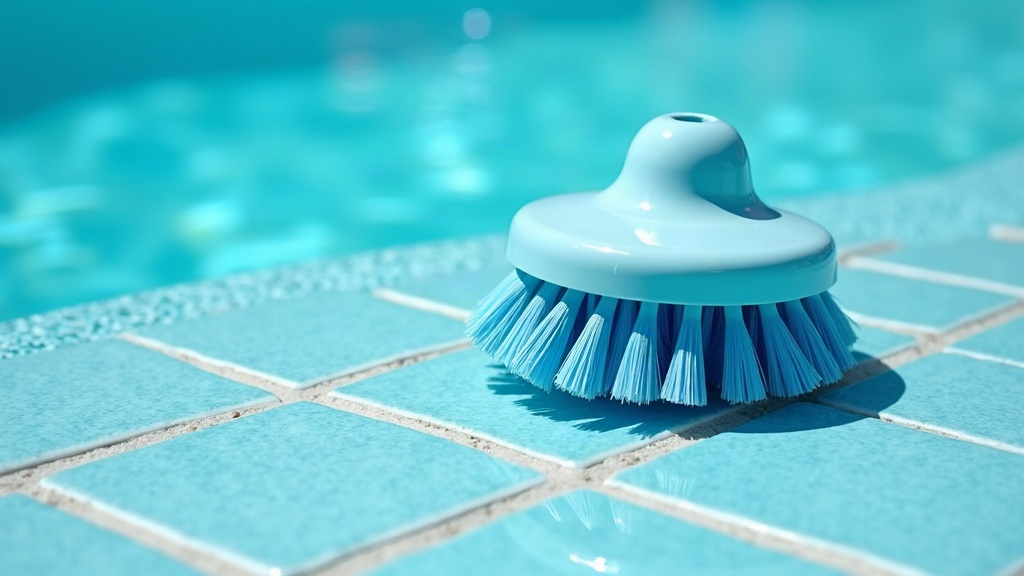
Most rings respond to a stiff pool-safe brush and some elbow grease, worked along the tile in short sections while the water level is at its normal height. For tougher, longer-standing rings, a purpose-made tile cleaner or a nylon pad matched to the tile’s finish can lift residue that a brush alone won’t shift.
Avoid household abrasive cleaners or scouring pads on glazed tile, natural stone or fiberglass, since they can dull the surface or scratch the gel coat, which then collects grime even faster afterward.
Regular brushing keeps the ring from building into a hard, set-in stain in the first place. How often a pool should actually be brushed covers a realistic routine for most owners.
Can the ring be prevented from coming back?
It can be minimized but not fully eliminated in a pool that gets regular use. Practical habits that help include:
- Rinsing off sunscreen and lotion before getting in, where practical
- Keeping chlorine and pH in a steady, tested range rather than letting it swing
- Running the pump long enough each day to keep surface water moving toward the skimmer
- Brushing the waterline on a regular schedule instead of waiting until the ring is obvious
- Using a cover when the pool sits unused for stretches, to cut down on dust and pollen
For pools that develop a heavy ring quickly no matter what’s done, it’s worth checking overall water clarity and balance together — a look at what actually makes pool water clear and why pool water goes cloudy often points to a circulation or sanitizer issue that’s showing up at the waterline first.
When is it worth asking for help?
A waterline ring that keeps returning heavily within days of cleaning, especially alongside cloudy water or a strong chemical smell, is usually a sign that circulation, filtration or sanitizer levels need attention rather than the tile itself. The cleaning and maintenance section and pumps, filters and heaters section are good places to work through the possibilities systematically before assuming the tile or grout is at fault.
Any chemical product used to treat or clean a waterline stain should be handled according to its own label — stored away from other pool chemicals and never mixed with anything else, since combining pool chemicals, particularly chlorine products and acids, can produce dangerous gas.
Pools Shop publishes general information, not professional advice. Pool chemicals, electrical work and structural work are genuinely hazardous and are governed by local codes that vary — use a qualified professional for anything you are not certain about, and follow the instructions on the product in front of you rather than a general guide. Nothing here is a substitute for active adult supervision around water: no cover, alarm, fence or device makes a pool safe on its own.