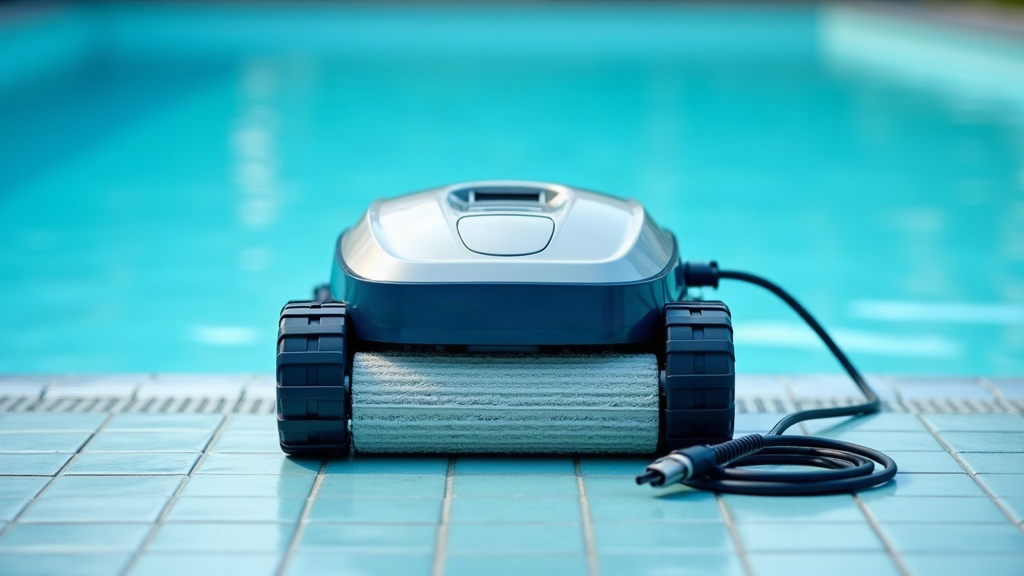
A robotic pool cleaner drives itself around the pool on a set cycle, scrubbing the floor and walls with brushes while vacuuming debris into an internal filter bag or basket. It runs independently of the main pump and filter system, and it does not test, balance or sanitize the water in any way.
What does a robotic pool cleaner physically do in the water?
It moves along the floor, walls, and sometimes the waterline on wheels or tracks, following a programmed pattern or sensor-guided route. As it moves, spinning brushes loosen dirt, algae film, and fine debris from the surface it’s touching, and an onboard pump pulls that debris into a filter compartment inside the unit itself.
This is a self-contained loop. Water goes in one side of the robot, passes through its internal filter, and comes back out the other side. The pool’s main pump and filter system are not involved in this process at all. That’s the core difference between a robotic cleaner and a suction-side or pressure-side cleaner, which both rely on the pool’s own circulation and plumbing to move water and debris.
Does a robotic cleaner replace the pool pump or filter?
No. A robotic cleaner and the pool’s circulation system do two different jobs. The robot picks up settled debris and scrubs surfaces; the pump and filter keep water moving and remove fine particles and contaminants from the entire body of water, continuously.
Water still needs to pass through the pool pump and filter on a regular schedule, a concept covered under turnover rate, even on days when the robot runs a full cleaning cycle. Skipping circulation because “the robot cleaned it” is a common misunderstanding — the robot handles what’s on surfaces, not what’s suspended or dissolved in the water column.
What kinds of debris does it actually pick up?
Robotic cleaners are built to handle settled solids: leaves, twigs, sand, dirt, and algae that has attached itself to the floor, walls, or steps. Most models have a filter bag or cartridge basket that catches this material as the unit moves.
- Loose leaves and organic debris that have sunk to the bottom
- Fine silt and sand that regular skimming misses
- Algae film or light growth clinging to plaster, tile, or vinyl
- Debris caught in corners and steps that a skimmer can’t reach
What it does not do is filter dissolved chemistry, adjust sanitizer levels, or remove things that are floating or suspended mid-water — that’s the job of ongoing circulation and filtration working together.
Does a robotic cleaner replace brushing?
Not entirely. Many models scrub effectively on flat, open areas, but tight corners, steps, waterline tile, and areas around fittings often still need a hand brush to fully break up buildup, especially algae that has a foothold.
The general guidance around how often a pool should be brushed still applies even with a robot in regular use. Think of the robot as reducing the frequency and effort of manual brushing, not eliminating it, particularly on textured surfaces like plaster or pebble finishes where algae can grip more stubbornly.
How does a robotic cleaner compare to suction-side and pressure-side cleaners?
A robotic cleaner runs its own independent pump and filter, while suction-side and pressure-side cleaners depend on the pool’s circulation system to move and filter debris. This affects how much load each type puts on the main pump and filter.
Suction-side cleaners pull debris through the pool’s own skimmer line and rely on suction to move around, which means they add wear to the main pump and can push fine debris into the filter, affecting how soon it needs attention — relevant to when a filter needs cleaning rather than backwashing. Pressure-side cleaners work off return-line pressure and usually need a booster pump. Robotic cleaners bypass all of that, running on their own low-voltage transformer and motor, and they don’t add hydraulic load to the pool’s existing plumbing at all.
That independence is one reason robotic cleaners are often chosen alongside different filter types discussed in sand vs. cartridge vs. DE filters — the robot’s own filter basket is separate from whatever media the main system uses.
Does a robotic cleaner do anything for water chemistry?
No. It has no ability to test or adjust pH, sanitizer levels, alkalinity, or any other chemical reading. Removing physical debris can help reduce organic load in the water, which in turn can make sanitizer work more efficiently, but that’s an indirect effect, not a chemistry function.
Regular testing still matters regardless of how clean the pool looks. A pool can appear spotless from robotic cleaning and still have unbalanced water — topics like pH, total alkalinity, and what’s covered under water chemistry generally are unaffected by a cleaning robot’s presence. Reading a test kit or strip, as described in test strips vs. liquid test kits, remains the only way to know what’s actually happening chemically.
Clear water and low-algae conditions are also shaped by factors the robot has no influence over, such as what’s discussed in what causes algae to take hold and what actually makes pool water clear.
Do robotic cleaners help with cloudy water?
Only indirectly, and only if fine debris on surfaces is contributing to the cloudiness. If cloudiness comes from chemistry imbalance, poor circulation, or a filter that needs attention, a robotic cleaner won’t resolve it.
Persistent cloudy water usually has a chemical or filtration cause, covered in more detail under why pool water goes cloudy. A robot picking up settled silt might reduce one contributing factor, but it’s not a substitute for checking the filter or testing the water.
Does a robotic cleaner reduce how often the filter needs attention?
It can reduce the load on the main filter somewhat, since less debris is circulating through it when a robot handles settled material separately. But cartridges, sand, and DE grids still accumulate residue from what remains suspended in the water and still need routine attention.
General filter cartridge lifespan, discussed in how long filter cartridges last, and processes like backwashing still apply on their normal schedule. A robotic cleaner is a helpful addition to a maintenance routine, not a replacement for any part of it — including the basics laid out under pumps, filters and heaters or the wider routine covered in cleaning and maintenance.
Is a robotic cleaner electrically safe to use around a pool?
Robotic cleaners are designed to run on a low-voltage supply through a transformer that sits away from the water, and manufacturers provide specific instructions on cord handling, storage, and use near the pool. Any question about how that transformer is wired into a home’s power supply, grounding, or bonding near the pool is electrical work for a licensed electrician, not a DIY task.
Anyone unsure whether an outlet, GFCI protection, or wiring setup near the pool meets local requirements should ask a licensed electrician rather than guess. Local code varies by region, and permit or inspection requirements should always be checked directly with local authorities.
Does having a robotic cleaner change anything about supervising children near the pool?
No, and it’s worth being direct about this: a cleaning robot has nothing to do with drowning prevention. It doesn’t detect a person in the water, it doesn’t stop, and it isn’t a safety device in any sense.
Pool safety is layered — physical barriers, alarms, learning to swim, and constant supervision all play a role — but supervision by a designated adult who is actively watching the water is the layer that actually matters in the moment. No cover, cleaner, alarm, or fence removes the need for that. Anyone setting up barriers or alarms should also check local code, since requirements for fencing and alarms vary by jurisdiction.
Is a robotic cleaner worth the cost?
That depends on pool size, how much debris the pool typically collects, and how much manual cleaning time an owner wants to reduce. Larger pools, heavy tree cover, or limited time for manual brushing and vacuuming tend to make the case stronger.
Cost varies by brand, features like programmable cycles or remote control, and build quality, and there’s no single figure that applies universally. It’s more useful to weigh it against other running costs and priorities covered in buying and costs, and to think about it as one part of an overall setup discussed in pool basics, rather than a standalone purchase decision.
Pools Shop publishes general information, not professional advice. Pool chemicals, electrical work and structural work are genuinely hazardous and are governed by local codes that vary — use a qualified professional for anything you are not certain about, and follow the instructions on the product in front of you rather than a general guide. Nothing here is a substitute for active adult supervision around water: no cover, alarm, fence or device makes a pool safe on its own.