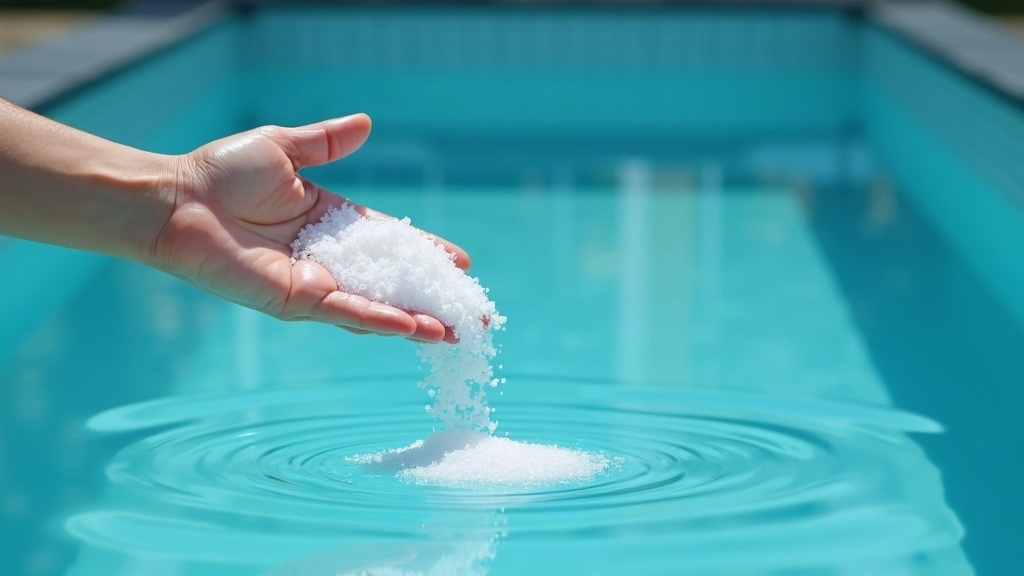
A saltwater pool is still a chlorine pool. Dissolved salt passes through a cell in the equipment pad, and an electrical process called electrolysis splits it apart, generating chlorine on the spot. The pool never runs on salt alone — it runs on chlorine the system makes itself, continuously, instead of chlorine added by hand.
How does a salt chlorine generator actually make chlorine?
Salt dissolved in the pool water flows through a cell containing metal plates. When water passes over those plates while power runs through them, a chemical reaction converts the dissolved salt into chlorine, which then disperses through the water to do the same sanitizing job any other chlorine source does.
The chlorine produced this way doesn’t stay as “salt” — it goes through the same cycle as chlorine added from a jug or tablet. It sanitizes, it reacts with contaminants, and much of it eventually converts to other compounds that need to be replenished by the cell running again. This is the same underlying chemistry described in what chlorine actually does in a swimming pool, just with a different source.
Is a saltwater pool actually chlorine-free?
No. A saltwater pool is not chlorine-free — it has chlorine in it at all times when the system is working correctly. The difference is where that chlorine comes from, not whether it’s present. Anyone sensitive to chlorine will still notice it in a salt pool.
This is a common misunderstanding worth clearing up before anyone assumes a salt pool needs no testing or that it behaves completely differently from a traditionally chlorinated one. It’s still chlorine doing the sanitizing, and the same rules about free versus combined chlorine apply — see free vs combined vs total chlorine for what those readings actually mean.
What does the salt itself do in the water?
The salt’s job is to sit dissolved in the water as a raw material for the cell to convert into chlorine. Once the salt level is established, it doesn’t get consumed the way chlorine does — small amounts are lost through splash-out, backwashing and dilution from rain or top-ups, but it isn’t burned off by sunlight or by sanitizing contaminants the way chlorine is.
Because of that, salt levels change slowly and only need occasional checking, while the chlorine the cell produces needs the same regular attention as any other pool. A test kit or strip reading total and free chlorine, along with pH, is still the way to know what the water is actually doing — see test strips versus liquid test kits for how those compare.
Why does a salt pool still need regular testing?
A salt system still needs testing because the cell can produce too little chlorine, too much, or an inconsistent amount depending on water temperature, salt level, and how hard the cell is working. Testing is the only way to know the chlorine level the water actually has right now.
pH also still needs watching. The electrolysis process tends to nudge pH upward over time, so salt pools often need more frequent pH attention than manually chlorinated ones, not less. The relationship between pH and total alkalinity is covered in total alkalinity vs pH, and calcium hardness still matters for the same reasons it does in any pool — see why calcium hardness matters.
Cyanuric acid, the stabilizer that protects chlorine from breaking down in sunlight, is just as relevant in a salt pool as any other, since the chlorine the cell produces is subject to the same sunlight losses. What cyanuric acid actually does explains why that balance matters.
What can go wrong with a salt cell?
A salt cell can wear down over time, produce less chlorine as it ages, or develop mineral scale on its plates that reduces output. Low water flow across the cell, low salt levels, or cold water can all cause it to underperform even when it appears to be running.
- Scale buildup on the cell plates, often linked to water balance issues rather than the cell itself.
- Salt level drifting below or above the system’s operating range.
- Reduced output as the cell ages, meaning chlorine production drops even though the display shows the system running.
- Flow problems caused by a dirty filter or a pump not moving enough water past the cell.
Most of these show up first as a chlorine reading that doesn’t match expectations, which is why testing the water directly — not just trusting the control panel — is the reliable check. A cell sits within the broader equipment pad, alongside the pump, filter and any heater; see what’s on a pool equipment pad for how it fits into that layout.
Does a saltwater pool need an electrician to install?
Yes, in most cases. A salt system draws power, ties into the pool’s electrical circuit, and often needs its own wiring path and bonding considered alongside the pump and any lighting. This is licensed electrical work, not a weekend project, and it should be planned alongside the rest of the equipment pad.
Anyone considering adding a salt cell to an existing pool should ask a licensed electrician what the job involves for that specific property, including permits and inspection requirements, since local code varies by area. The same applies to any other electrical work near water, including pumps and heaters — see what a pool pump actually does and the pumps, filters & heaters section for how these pieces connect.
Is a saltwater pool cheaper to run than a chlorine pool?
It depends on the specific pool, the cost of chlorine products locally, the cost of power, and how long the cell lasts before it needs replacing. There’s no universal number that applies everywhere, since running costs are driven by too many local variables to state as a fact.
What can be said is that a salt system shifts the ongoing cost from buying chlorine to running the cell and eventually replacing it, plus the upfront cost of the equipment and its installation. Anyone comparing the two paths should look at the full picture — equipment cost, installation, and consumables — rather than assuming one is automatically cheaper. The buying & costs section covers how to think through those comparisons.
Is a saltwater pool easier to maintain?
A salt pool removes the task of manually adding chlorine, but it doesn’t remove the need for regular testing, balancing pH, managing cyanuric acid, or keeping the water circulating properly. It changes one job, not the whole maintenance routine.
Water still needs to move through the filter and past the cell for chlorine to be produced and distributed, which is why daily circulation matters just as much in a salt pool as any other — see why a pool needs daily circulation and what turnover rate means for how that’s measured. Skipping circulation or testing because “it’s a salt pool” is a common way problems go unnoticed until the water turns cloudy or the chlorine reading is far off target.
What should be checked before switching a pool to salt?
Before converting, it’s worth checking the pool’s surface material, existing equipment, and local code requirements, since salt water can be harder on certain metal fittings, ladders and some pool finishes over time depending on what they’re made from.
- What the pool’s existing rails, lights, and fittings are made of, and whether the manufacturer notes any compatibility concerns with salt.
- Whether the existing pump and filter can support the flow the cell needs.
- What local permit or electrical inspection requirements apply to adding the system.
- What ongoing testing routine will be used, since one doesn’t disappear with the switch.
None of this replaces asking a pool professional to look at the specific equipment and site before committing to the conversion. For the basics of how a pool moves and treats water generally, the pool basics section and how a pool actually circulates water are useful starting points, and the water chemistry section covers the testing and balance side in more depth.
Pools Shop publishes general information, not professional advice. Pool chemicals, electrical work and structural work are genuinely hazardous and are governed by local codes that vary — use a qualified professional for anything you are not certain about, and follow the instructions on the product in front of you rather than a general guide. Nothing here is a substitute for active adult supervision around water: no cover, alarm, fence or device makes a pool safe on its own.