A winter cover’s main job is keeping out sunlight, leaves and debris while a pool is closed — it is not rated to hold weight. A safety cover is engineered and tested to span the pool and support the weight of a person or animal who steps onto it, reducing the chance of a fall-through. They solve different problems.
That difference matters more than it sounds. Confusing the two is one of the more common — and most dangerous — mix-ups pool owners make when closing a pool for the season.
What does a winter cover actually do?
A winter cover is a barrier against the elements, not against people or pets. It blocks sunlight that feeds algae, keeps leaves and debris out of the water, and reduces how much dirt has to be dealt with at opening. It sits on top of the water or is held down at the edges, but it is not designed to bear weight.
Most winter covers are made from woven or solid vinyl-type material, held in place with water bags, anchors, or a cable-and-winch system around the perimeter. Some solid covers can pool rainwater or meltwater on top, which adds weight and can make the cover sag toward the center. That sag is a visual clue that the cover is not — and was never meant to be — a walking surface.
For more on how a winter cover compares with a solar cover used in season, see Winter Cover vs Solar Cover: What Each One Actually Does.
What makes a safety cover different?
A safety cover is built and tested to specific load-bearing standards so it can support weight across its surface, typically anchored with straps into the deck around the entire perimeter. The goal is to reduce the risk of someone falling through, not to replace supervision.
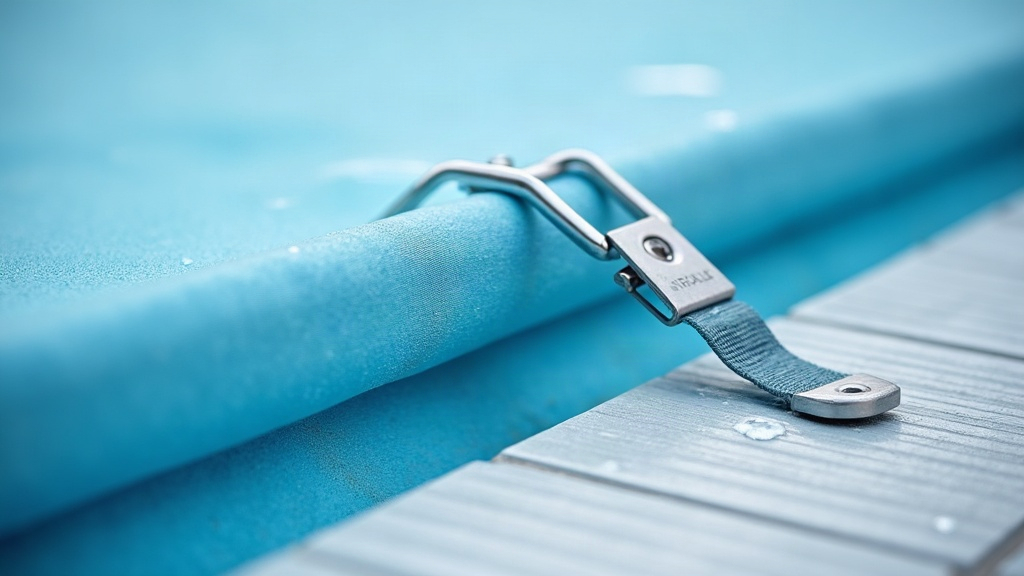
Safety covers are usually made from a tightly woven mesh or a solid vinyl material reinforced with webbing, and they attach to the deck with springs and straps set into anchors drilled around the pool’s edge. That perimeter anchoring, spaced closely and tensioned evenly, is what lets the cover hold weight without the center dropping. A winter cover, by contrast, typically rests loosely or is held down at only a few points, which is part of why it is not built to bear a load.
Reputable safety covers are usually tested against a recognized standard for barrier products, such as those published by ASTM International. If a cover is marketed as a “safety cover,” it is reasonable to ask the retailer which standard it was tested against and to ask for that documentation before buying.
Can a winter cover ever be used as a safety cover?
No. A winter cover has no rated capacity to hold weight, and using one as though it were a safety barrier is a real hazard, especially anywhere children or pets could reach the pool unsupervised. The two products are not interchangeable no matter how similar they look once installed.
A winter cover that looks taut and solid can still fail under weight in ways that are not obvious from the surface. Straps or clips meant only to keep the cover roughly in place, rather than to anchor it against a load, can pull loose. Anyone treating a winter cover as a barrier is relying on something it was never engineered to do.
Does a safety cover replace supervision or a fence?
No cover, of any kind, replaces an adult actively watching the water. A safety cover is one layer in a broader safety plan that also includes barriers, alarms and constant supervision whenever children or pets are near a pool — layered safety is the only approach that consistently works.
Local codes in many places require a compliant barrier or fence around a pool regardless of what cover is used, and some jurisdictions specify what qualifies as an approved safety cover for code purposes. It is worth checking local requirements directly rather than assuming a cover purchase satisfies them. See What Do Pool Barrier and Fence Codes Typically Require? for the kinds of rules that commonly apply.
For a fuller picture of how covers, fences, alarms and supervision fit together, What Does Layered Pool Safety Actually Mean? lays out how the layers work together, and none of them stand in for the others.
Do pool alarms make up for a weaker cover?
An alarm can add a layer of awareness, but it does not prevent a fall or replace watching the water — it can only alert someone after something has already happened. A cover’s strength and an alarm’s presence are separate protections, not substitutes for each other.
Anyone relying on a winter cover during the closed season, without a compliant barrier around the pool, should understand what an alarm can and cannot do before treating it as a safeguard. What Is a Pool Alarm, and What Can’t It Do? covers the limits plainly.
Which cover should a pool owner actually buy?
The choice depends on how the pool is used in the off-season and what local code requires, not on price alone. A pool that sits closed with no unsupervised access nearby has different needs than one near young children, pets, or frequent visitors.
- Winter cover: lower cost, keeps out sunlight and debris, no load-bearing capacity, needs a separate compliant barrier if children or pets can reach the pool area.
- Safety cover: higher upfront cost, professionally anchored, tested to bear weight, often accepted as part of a code-compliant barrier system in some jurisdictions — but always worth confirming locally.
Cost is genuinely hard to quote in general terms. A safety cover’s price depends on pool shape and size, the anchoring system, the material, and how much site work the installer needs to do around existing decking. A winter cover is usually far cheaper but delivers a narrower job. For a broader look at how pool costs get decided, see Buying & Costs.
What happens if a pool is left with the wrong cover, or none at all?
An uncovered or under-protected pool over winter tends to collect debris, lose water clarity, and — depending on climate — face freeze-related strain on plumbing and surfaces. None of these issues are safety issues on their own, but a pool that is neglected is also a pool where covers, anchors and hardware are more likely to be overlooked or degraded when they matter most.
For what actually happens when a pool sits uncovered through the off-season, see What Happens If a Pool Is Left Uncovered Over Winter?. And for the bigger picture of what closing a pool properly involves, What Does Winterising a Pool Involve? A Clear Guide is a useful starting point.
How should a cover be checked before relying on it?
Any cover — winter or safety — should be inspected regularly for wear, loose anchors, sagging, or standing water pooling in the middle. A safety cover in particular should have its straps, springs and anchor points checked each season, since these are the parts doing the structural work.
- Look for frayed straps, cracked buckles, or anchors that have worked loose from the deck.
- Check that springs are still under even tension around the full perimeter, not just at a few points.
- Clear standing water or debris off the top rather than letting weight build up.
- Replace a safety cover once the manufacturer’s inspection or warranty guidance says it is due, rather than judging by appearance alone.
None of this inspection routine changes the core rule: a cover of any kind is a barrier layer, not a substitute for a designated adult watching the water whenever anyone could be near it.
Where does a cover fit with the rest of closing and opening a pool?
Choosing the right cover is one part of a larger seasonal routine that includes water balance, equipment protection and freeze precautions. Getting the cover right without addressing the rest of the closing process still leaves gaps.
For the full seasonal picture, the Opening & Closing hub covers what happens at both ends of the season, including Why Blowing Out the Lines Matters When Closing a Pool and What Actually Happens When a Pool Is Opened for the Season?. For everything else related to keeping a pool and its surroundings genuinely layered for safety, the Safety hub is the place to start.
Pools Shop publishes general information, not professional advice. Pool chemicals, electrical work and structural work are genuinely hazardous and are governed by local codes that vary — use a qualified professional for anything you are not certain about, and follow the instructions on the product in front of you rather than a general guide. Nothing here is a substitute for active adult supervision around water: no cover, alarm, fence or device makes a pool safe on its own.