A typical week of pool maintenance is about 30–60 minutes: testing the water two or three times, brushing and skimming, emptying baskets, checking the filter pressure gauge, and adding what the test results call for. Heavier jobs like backwashing, shocking or vacuuming come around less often, and time goes up sharply in hot, busy weeks and after storms.
What actually needs doing every week?
Every week, a pool owner needs to test the water, skim the surface, empty skimmer and pump baskets, brush the walls and steps, and glance at the filter pressure gauge. These are the small, repeated tasks that keep water clear and equipment running without surprises.
- Testing chlorine and pH, and other readings depending on the water and season
- Skimming leaves and debris off the surface
- Emptying the skimmer basket and pump strainer basket
- Brushing walls, steps and corners where algae tends to start
- Checking the filter pressure gauge against its clean, freshly-backwashed reading
- Looking over the water level and topping it up if it has dropped
None of this takes long individually, but skipping it for a few weeks in a row is usually how a pool ends up needing a bigger fix. For background on why circulation matters between these check-ins, see why a pool needs daily circulation.
How much time does testing actually take?
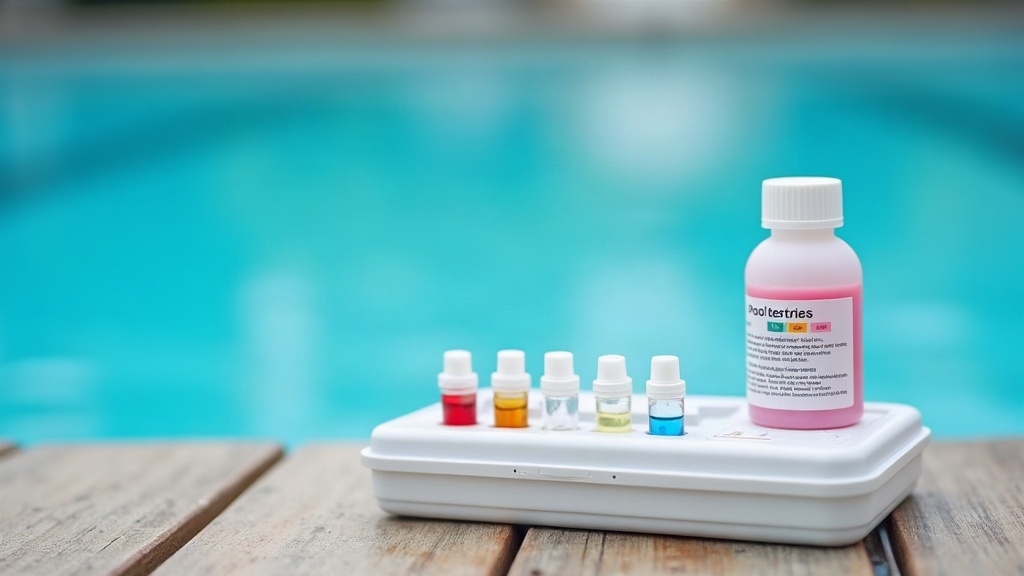
Testing water usually takes five to ten minutes, whether using test strips or a liquid kit, plus a minute or two to note the results. The time is in reading the numbers correctly and deciding what they mean, not in the test itself.
What gets tested varies by pool and season, but chlorine and pH are the two numbers checked most often, since both drift quickly with sun, bather load and rain. Total alkalinity, calcium hardness, cyanuric acid and phosphates are checked less frequently, often every few weeks rather than every visit. For a look at the two main testing methods, see test strips versus liquid test kits, and for what the numbers actually mean day to day, the water chemistry hub covers pH, alkalinity and chlorine in more depth.
Whatever the readings show, the correct amount of any product to add depends on the pool’s volume, the current readings, and the specific product’s strength. That number is always on the label of the product in front of the reader — not something a general article can state.
What does cleaning actually involve week to week?
Weekly cleaning means skimming the surface, brushing submerged surfaces, and clearing baskets so water keeps moving freely. A cleaner (manual, suction, pressure or robotic) usually runs on its own schedule on top of this, rather than replacing it.
Brushing matters more than most owners expect, because algae takes hold on surfaces before it shows up as color in the water. A quick pass over walls, steps, and any shaded corners breaks up the early film before it becomes a visible problem — more on that at how often a pool should be brushed and what causes algae to take hold in a pool.
Whether a cleaner does the vacuuming or a person does it manually, the choice affects how much hands-on time a pool needs each week. The differences between suction, pressure and robotic units are laid out at suction vs pressure vs robotic cleaners.
How often should the filter be checked, and does it need backwashing every week?
The filter pressure gauge is worth a quick look every week, but backwashing or cleaning is only needed when pressure rises noticeably above its clean baseline — not on a fixed weekly schedule. Backwashing too often wastes water; ignoring it strains the pump and cuts filtration.
What “noticeably higher” means depends on the filter type and its own clean-start reading, which is why it helps to note that baseline the first time it’s backwashed or cleaned. The filter pressure gauge guide explains how to read that number, and what backwashing a filter does covers what the process actually achieves. Cartridge filters work differently again — see when a filter needs cleaning rather than backwashing for the distinction. The broader pumps, filters & heaters hub is a good starting point for equipment questions generally.
Does the pump need weekly attention too?
The pump mostly needs a glance — checking it’s running, priming properly, and not making unusual noise. Anything beyond that, such as a persistent hum, a burning smell, or a pump that won’t hold prime, is a sign to look into the cause rather than something to adjust weekly.
A pump that keeps losing prime, runs constantly hot, or trips a breaker repeatedly should not be worked on as a DIY electrical task. Pumps, wiring and bonding near pool water are governed by local electrical code for good reason, and that work belongs with a licensed electrician or pool professional. For background on why, see electrical hazards around a pool and what bonding and grounding around a pool means. For troubleshooting signs before calling someone, signs a pool pump is failing and what causes a pool pump to lose prime are useful reading.
How does the weekly workload change through the season?
Early in the season and right after storms, weekly maintenance takes longer because water chemistry swings more and debris is heavier. In the settled middle of summer, with steady bather load and no rain, the same routine tends to take less time.
- Just after opening: heavier testing and cleaning while the water stabilizes
- After heavy rain: extra testing, since rain dilutes and shifts pool chemistry
- Peak summer, heavy use: more frequent chlorine checks and basket emptying
- Approaching closing: shifting from weekly upkeep to a closing routine
Rain in particular catches owners off guard — see why rain changes pool water chemistry for why a single storm can undo a week of steady readings. And a pool that turns green shortly after being reopened is almost always the result of a few missed weeks beforehand, explained at why a pool turns green right after opening.
What jobs come up monthly or seasonally instead of weekly?
Some tasks don’t belong on a weekly list at all — they come around every few weeks, once a season, or only when something changes. Knowing which is which stops a routine from becoming either neglected or over-serviced.
- Deep-cleaning or replacing filter cartridges, on their own service schedule
- Checking calcium hardness, cyanuric acid and phosphates less often than chlorine and pH
- Shocking the water after heavy use, rain, or visible cloudiness
- Opening and closing routines at the start and end of the swimming season
The opening and closing seasons carry their own separate checklist, distinct from the weekly routine — covered in the opening & closing hub, including what winterising a pool involves and what happens when a pool is opened for the season.
What about chemical storage and handling while doing this weekly routine?
Weekly maintenance means handling pool chemicals regularly, and the one rule that matters every time is that chlorine products and acid must be stored separately and never combined. Mixing them can produce toxic gas, and this has caused real harm — it is not a theoretical warning.
Chemicals should be kept in a cool, dry, ventilated space, out of their original mixing path with each other, and away from anywhere children can reach. More detail on doing this correctly is at why pool chemicals should never be mixed and pool chemicals and storage: what owners need to know.
Does a pool with children around change the weekly routine?
Testing, cleaning and equipment checks don’t change because children use the pool — but no weekly routine, cover, alarm or fence changes the fact that nothing substitutes for a designated adult actively watching the water whenever anyone is in or near it.
Safety around a pool is layered: barriers, alarms and covers each reduce risk in a specific way, but none of them is a substitute for supervision. For how these layers fit together, see what layered pool safety actually means and why supervision is still what matters most. The safety hub covers barriers, alarms and first aid setup in more depth.
Is a hot tub’s weekly routine the same?
No — a hot tub holds far less water at a much higher temperature, so its chemistry shifts faster and needs more frequent attention, often several times a week rather than once. The routine also differs because filtration cycles, foam and biofilm behave differently in a small, warm volume of water.
Owners moving between a pool and a hot tub routine should not assume the same weekly rhythm applies — see how hot tub water chemistry differs from a pool and the hot tubs & spas hub for the specifics.
Is this routine worth the time, or should it be outsourced?
Whether to DIY or hire a pool service usually comes down to time, comfort with routine testing, and how much the pool gets used. Either way, the weekly workload is a real, recurring cost of owning a pool that’s worth planning for before buying — not after.
Anyone weighing up a first pool, or already surprised by how much upkeep it takes, may find it useful to read the ongoing pool jobs nobody mentions before you buy and what a pool costs to run each year. For general orientation, the pool basics hub and buying & costs hub are good starting points.
Pools Shop publishes general information, not professional advice. Pool chemicals, electrical work and structural work are genuinely hazardous and are governed by local codes that vary — use a qualified professional for anything you are not certain about, and follow the instructions on the product in front of you rather than a general guide. Nothing here is a substitute for active adult supervision around water: no cover, alarm, fence or device makes a pool safe on its own.